
Turn what you know into a working brief.
Formats, labels, units, and condition observations.
Who needs to find what, and by which fields.
Sample, exceptions, review criteria, and handoff.
Two common widths. Many recording layouts.
Often document-oriented collections
Often larger originals or drawings
Keep labels, carriers, and sequence together
Retain existing box, drawer, reel, fiche, jacket, card, and label relationships. A handwritten container number, target, visible header, or drawing register reference may be the only link between a source microform and its filing system. Capture or transcribe the information in an approved inventory rather than separating it from the material to make counting easier.
Group clearly different physical formats for description, not for speculative reorganization. For example, identify open reels, cartridges, cassettes, gridded fiche, jacket fiche, and aperture cards as separate media groups. Within each group, note any mixed sizes, polarity, layout, or reduction clues that would make a single workflow assumption unreliable.
Observe condition without diagnosing it
National Archives guidance recommends handling film and fiche by the edges with gloves to avoid transferring oils and other substances. Inspect for scratches, dirt, distortion, curled fiche, damaged jackets, broken film, redox blemishes, or other visible issues. Keep equipment and work surfaces clean to reduce scratch and abrasion risks.
Do not diagnose nitrate, acetate deterioration, emulsion type, or generation from age, color, or a box label alone. Acetate and nitrate have different preservation considerations, and uncertain or damaged material may require a preservation specialist. Do not use household tape to repair broken film.
Record the attributes that affect planning
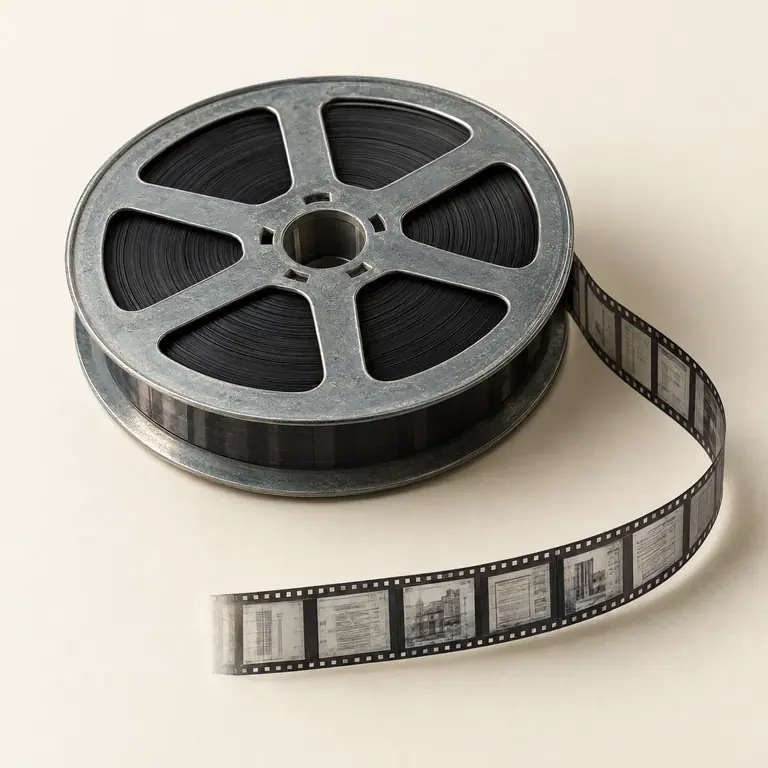
For roll film, record carrier, width, reel or core information, polarity, simplex or duplex layout, orientation, reduction when known, targets, image marks, labels, and condition observations. For fiche, include header, sheet dimensions, grid, fiche type, jacket/channel/strip relationships where applicable, and any visible sequence. For aperture cards, include aperture count, card labels, punched status, and drawing-register availability.
Also record the intended outcome separately: access images, an index, OCR/search support, requested file roles, or preparation for a customer-defined repository. Physical attributes and delivery requirements inform one another, but one does not determine the other.
Use representative material to frame decisions
A sample should represent meaningful variation: common material, difficult density or focus, different reductions, a typical jacket, damaged examples, or cards with and without punch patterns. The purpose is to identify questions early, not to make a blanket claim about all remaining material.
Fictional example — no PII: “Sample set includes two 16 mm reels with different targets, one 35 mm duplex reel, three COM fiche, two jacket fiche with shifted strips, and ten aperture cards with mixed punched status.” This gives reviewers a factual picture of variation.
Common questions
Should I clean or repair film before a digitization discussion?
Do not undertake repairs or use household tape. Record visible condition and seek appropriate preservation guidance for damaged or uncertain material.
Should mixed media be separated?
Describe and group them for inventory purposes while retaining existing order and associated labels. Do not discard the relationships that explain the collection.
What is the most useful first inventory field?
Carrier form is a strong starting point, followed by identifiers, dimensions, visible labels, condition observations, and the retrieval outcome needed.
Sources & further reading
These references explain technical formats, standards or destination requirements. They do not imply endorsement of National Microfilm.