
Read film clues as separate attributes
Width, carrier, layout and polarity answer different questions. Keeping them separate creates a clearer description of the material in front of you.
Width
16mm and 35mm describe measured film width, not a paper size.
Carrier
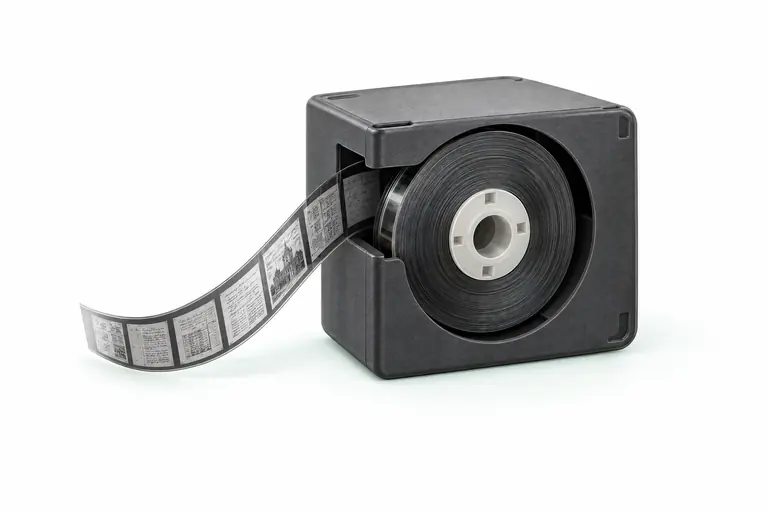
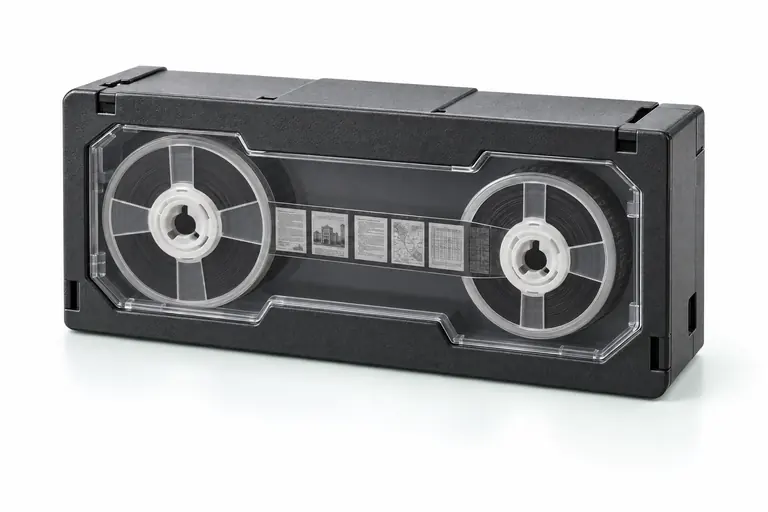
A cartridge has one hub; a cassette encloses two cores.
Layout
Simplex is one-up and duplex is two-up; this does not mean paper front and back.
Simplex and duplex guidePolarity
Positive has dark text on a light background; negative reverses that relationship.
Positive and negative guide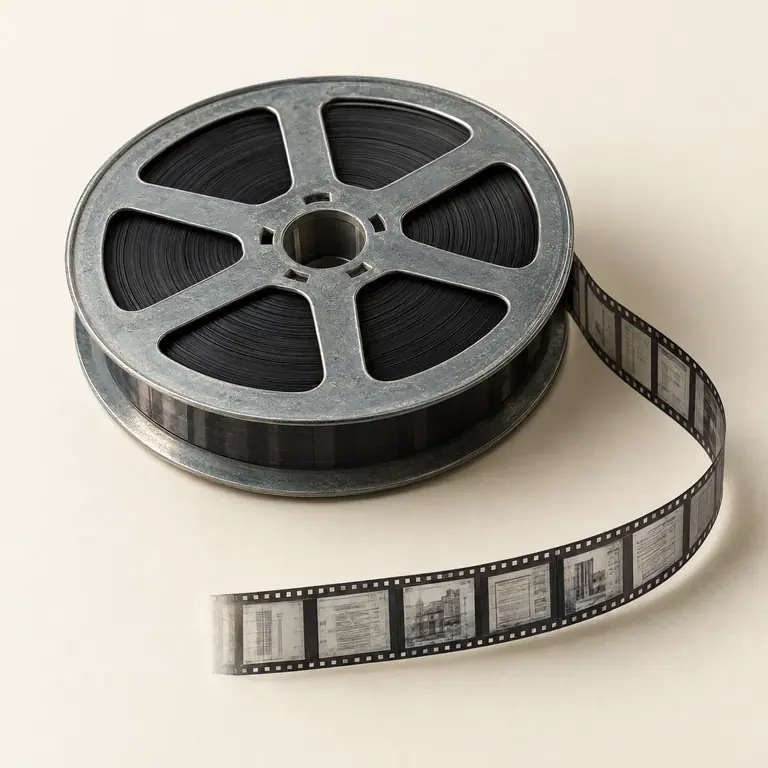
Blips or optical marks
Marks can appear as distinct rectangles along a film edge. Their meaning is collection-specific.
Blipped film image marks guideStart with the carrier and film
Microfilm is roll-form microform: a sequence of miniaturized images on film. Common document-film widths are 16 mm and 35 mm. The width describes the film, not the original paper size and not a recommended digital resolution. A reel, loose roll, cartridge, and cassette are different carriers with different access considerations, so they should not be counted or described as interchangeable.
A project conversation is more productive when it separates known facts from assumptions. Labels, targets, reel size or core information, visible frame sequence, and any reader or catalog notes provide useful evidence. Film inside a cartridge should not be removed merely to identify it; the National Archives cautions that access and handling can require collection-specific preservation advice.
- Carrier: open reel, loose roll, cartridge, cassette, or mixed batch
- Film attributes: 16 mm or 35 mm, positive/negative/mixed polarity, known reduction
- Layout clues: simplex or duplex, cine or comic orientation, image marks or blips
- Use goal: access images, retrieval fields, OCR support, or a delivery package
Capture choices follow the source
A nominal scanner setting alone does not establish whether fine detail is usable. FADGI distinguishes sampling at the film plane from the historical size of the original document. Reduction ratio, lens and sensor performance, focus, density, processing, and the film itself all influence the digital image that results.
Representative material can help define what the project needs to preserve and what users need to read. This is especially important when a roll contains changes in reduction, mixed polarity, irregular targets, faint images, or a mixture of document sizes. The agreed specification can then state the requested file role, frame treatment, metadata, and review approach without treating one setting as universal.
Build a route back to the source
Scanning creates images; indexing creates dependable ways to find them. Useful fields may include collection or series, reel identifier, frame range, visible date, title, case or account reference, and source-page number. Where blips or other image marks are present, their meaning should be verified before they are used as record boundaries.
OCR can add a searchable text layer where printed content and image quality support it. It is not a replacement for the original image or a guarantee that faint type, handwriting, dense pages, or damaged frames will become fully searchable. For retrieval fields that must be consistently found, a project can use a documented index map and agreed exception handling.
Information that helps scope a microfilm project
Provide whatever is already available: approximate reel or box counts, representative labels, known widths, any existing reel list, condition observations, and the intended digital destination. Preserve existing order and associated labels. They often contain the context needed to connect a digitized frame to the collection it came from.
National Microfilm reviews requirements per project, including requested outputs and metadata. We can discuss scanning, indexing, OCR, and customer-defined delivery needs without assuming a fixed format, condition, resolution, or import workflow for every collection.
Roll-film scanning: define capture and review together
A microfilm scanning project should define more than a reel count. Representative samples help establish frame boundaries, orientation, simplex or duplex layout, targets, image marks and the source references that should accompany the files. Separate treatment may be needed when records change size, polarity or layout within a reel. Width alone does not fix page count or a suitable capture resolution.
Agree whether paired images remain together or are separated, how target and blank frames are handled, and how unreadable or unusual frames are recorded. The review should connect delivered records back to their source, rather than silently losing exceptions. Newspaper reels introduce additional title, issue, edition and page-order questions; they have their own project-planning page.
- Identify the carrier and review representative frames before setting a production specification.
- Agree the record boundary, image sequence, naming rule and source reel/frame references.
- Define a sample review and exception convention alongside any requested OCR.
Technical references:[1]
Go deeper on the material you have.
Detailed identification clues, capture considerations and retrieval questions for these formats.
Common questions
Are 16 mm and 35 mm the same kind of project?
They are common microfilm widths, but width alone does not determine layout, reduction, image quality, indexing needs, or output requirements.
Can a cartridge be treated like an open reel?
No. A cartridge is a different carrier. Its accessibility and handling should be reviewed before a workflow is defined.
Does scanning make every roll searchable?
Searchability depends on the source images, OCR scope, and indexing design. OCR can support retrieval but is not a blanket accuracy promise.
Sources & further reading
These references explain technical formats, standards or destination requirements. They do not imply endorsement of National Microfilm.