
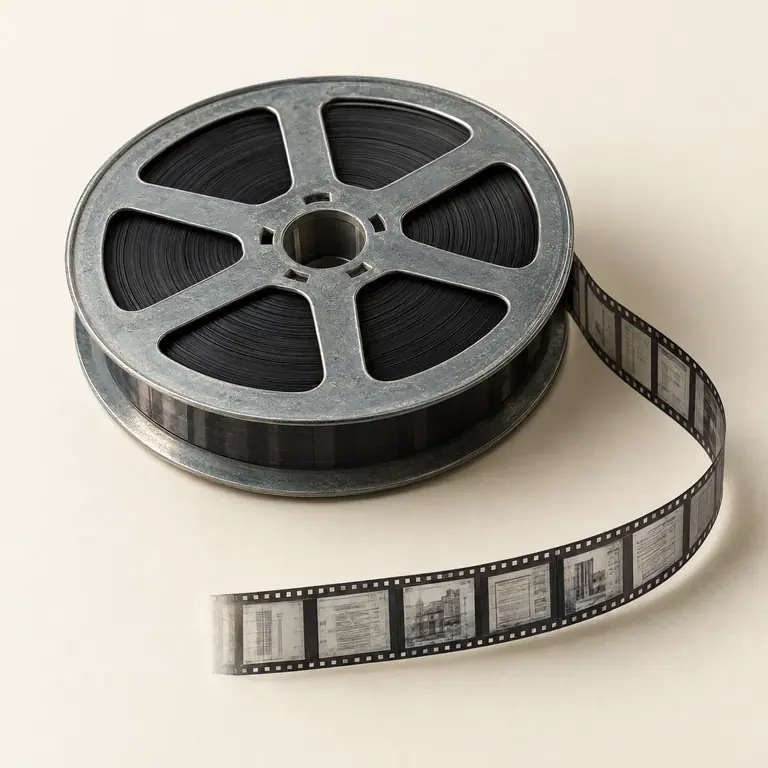
Recognize the format.
Identify polarity by whether readable lines and characters are dark on light or light on dark, then record it separately from carrier and other film attributes.
- Dark lines on a light background indicate positive polarity.
- Light lines on a dark background indicate negative polarity.
- Different frames may visibly alternate between the two appearances.
Positive and negative microfilm/microfiche: what to look for
Three useful notes for your project
- Record positive, negative, mixed, or unknown for each homogeneous batch.
- Flag frame ranges where the visible polarity changes.
- Supply representative images showing typical and difficult density or detail.
What positive and negative mean
A positive microimage has dark lines and characters on a light background. A negative microimage has light lines and characters on a dark background. This direct visual test applies to microfilm reels, microfiche grids, jacketed strips, and mounted aperture-card film; it does not rename the carrier.
The Library of Congress treats positive, negative, mixed, and unknown as separate polarity values. A single roll, fiche, or batch can be mixed polarity, so a label such as “negative film” should be checked against representative images rather than applied to every frame automatically. View the image with appropriate transmitted light and note whether its readable lines are dark or light.
Technical references:[1]
Keep polarity separate from format and material
Polarity is one image attribute among several. Name the carrier separately—reel, roll, cartridge, cassette, fiche, jacket, or aperture card—then record width or sheet dimensions, image layout, reduction ratio, and polarity. A positive 16 mm reel and a negative 16 mm reel share width but not necessarily the same image appearance or capture treatment.
Do not infer emulsion, film base, generation, or condition from whether an image looks positive or negative. The Library of Congress lists emulsion, generation, and base as distinct characteristics, and NARA cautions that film-support dates overlap. COM means computer-output microfilm; it describes computer-generated images, not a polarity or a bibliographic catalog. A jacket is a transparent carrier with channels for cut microfilm strips, not a fixed-grid fiche.
Why polarity matters during capture and review
Polarity changes the preview and the relationship between text, linework, and background. A negative may need inversion for a normal-reading access image, but capture and processing choices should be documented. Inversion cannot restore blurred, cropped, scratched, or missing information.
Use representative samples where both polarities, density variation, fine linework, or high reductions occur. FADGI explains that microfilm is digitized at a fixed PPI relative to the film, not automatically to the original paper size, and that sharpening only changes local contrast. Illustrative review case: judge a negative engineering-drawing frame with faint white dimensions after sample capture at the intended use size, not from a scanner-menu value alone.
Index polarity, then choose OCR and output rules
Record visible polarity with carrier, identifier, sequence, frame reference, reduction when known, and layout facts. This preserves traceability when access images are inverted and prevents an inverted derivative from being mistaken for the original microimage.
OCR is a text-recognition layer, not a substitute for the image or a guaranteed result. Small characters, dense or faint images, high reductions, complex columns, handwriting, and damaged frames can limit recognition. Illustrative indexing example: for fiche “RPT-1987-04,” retain fiche ID `RPT-1987-04`, row `07`, column `12`, polarity `negative`, report date, and capture filename; OCR supports search while row and column remain a stable source reference.
Output decisions should be agreed after sample review. A project may retain a documented master capture and supply normal-reading access derivatives where approved, while keeping the original polarity value in the index or metadata.
Prepare material without changing it
Keep original order, labels, targets, fiche headers, jacket/channel relationships, and any existing finding aids together with the collection. At intake, flag observed positive, negative, or mixed polarity; identify frames that differ from the predominant appearance; and provide a small representative sample that includes typical and difficult images. Do not alter a frame to make it appear consistent with its neighbors.
Handle microfilm and microfiche by their edges with gloves. Note scratches, dirt, distortion, redox blemishes, broken or shifted strips, and other visible issues for review rather than attempting home repair. NARA advises against Scotch tape for broken film and recommends preservation guidance for deteriorated material or when film inside a cartridge would need removal. Do not dismantle a single-hub cartridge or a two-core cassette.
Questions to bring to a sample review
Confirm whether the sample includes all observed polarities, whether inversion is wanted only for access copies, and whether mixed-polarity sections need separate handling or file naming.
Ask what must be found later: a date, account reference, report period, drawing number, fiche row and column, or roll/frame sequence. For aperture cards, a punched pattern needs its originating code map before it becomes structured metadata; scanning does not create editable CAD geometry. The answers help National Microfilm propose sample-based scanning, indexing, OCR, and approved delivery scope.
- Which carrier forms, widths or fiche sizes, layouts, and polarities are present?
- Are targets, headers, labels, blips, registers, or a punch-code map available?
- Which fields must be reliably retrievable, and which are only helpful search text?
- Should normal-reading derivatives be supplied while original polarity remains documented?
Common questions
How can I tell whether microfilm is positive or negative?
With transmitted light, positive microfilm has dark lines and characters on a light background; negative microfilm has light lines and characters on a dark background. Check representative frames because one item can contain mixed polarity.
Is a negative microfilm record damaged or lower quality?
No. Negative describes tonal polarity, not quality, film base, emulsion, or record value. Legibility depends on the filmed image, reduction, focus, density, condition, and capture approach.
Does a negative scan have to be inverted?
Not necessarily. A normal-reading inverted derivative may be useful for access, but the decision should follow sample review and the original polarity should remain documented as source metadata.
Can OCR read both positive and negative microforms?
OCR can be tested on either polarity after suitable image preparation, but it is not guaranteed. Tiny, faint, high-reduction, damaged, handwritten, or complex-layout content may need visual review and structured indexing.
Sources & further reading
These references explain technical formats, standards or destination requirements. They do not imply endorsement of National Microfilm.
- Library of Congress MARC 21: 007 Microform
- National Archives: Film-Based Negatives and Positives
- FADGI Technical Guidelines for Digitizing Cultural Heritage Materials
- GPO Quality Attributes for Microforms
- Library of Congress: Microfilm Selection for Digitization
- National Archives: Specific Media Type Authority List
- National Archives: Digital Imaging and Storage Report
- National Archives: Records Management Transfer Guidance