
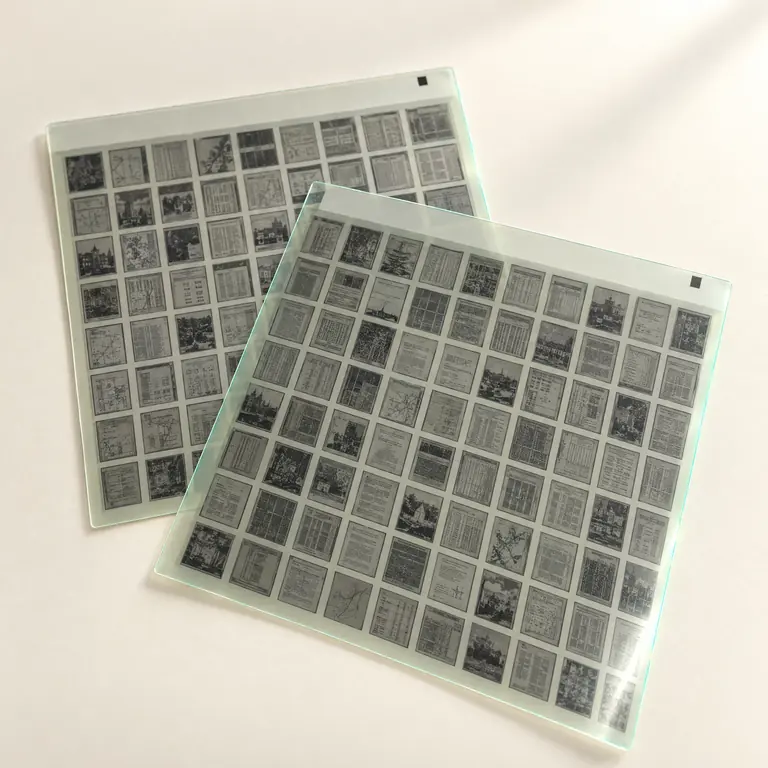
Four ways fiche can carry information
Form, production method and reduction are different dimensions, so these descriptions are not all mutually exclusive. A sheet count is not a page count, and grids vary by collection.
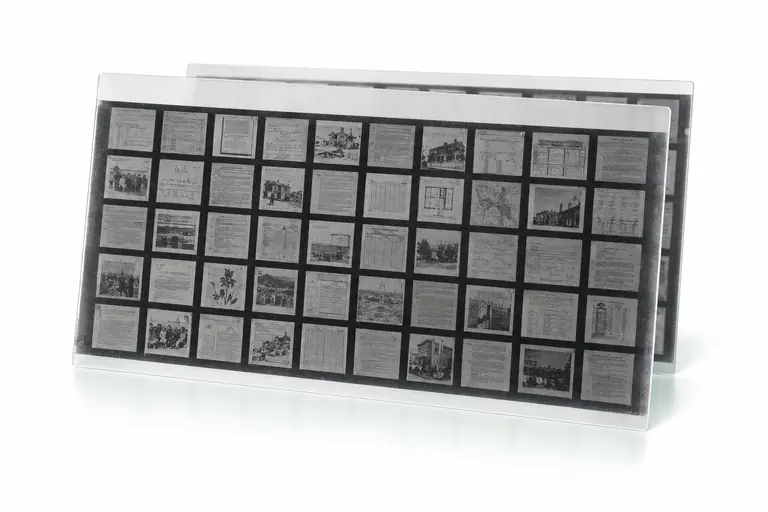
Source-document / step-and-repeat
A source document is reduced and placed frame by frame onto a fiche sheet. The header is retained separately from the image grid.
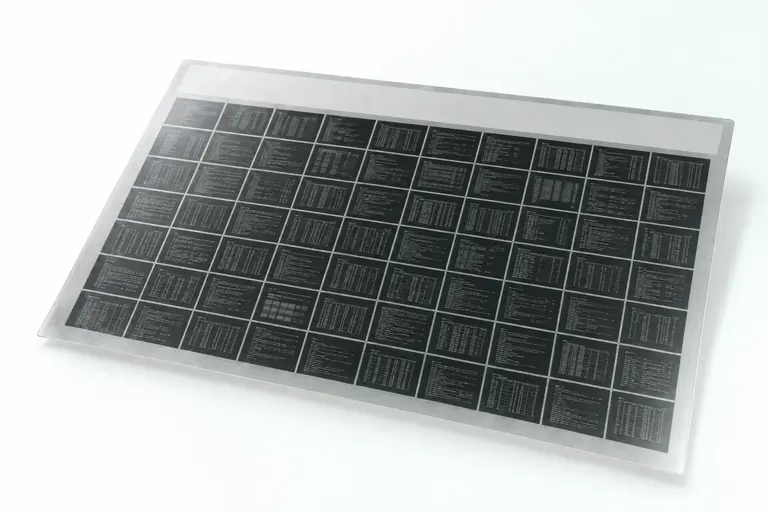
COM
Computer-output microfiche records computer-generated reports to fiche. COM is not a bibliographic catalog by definition.
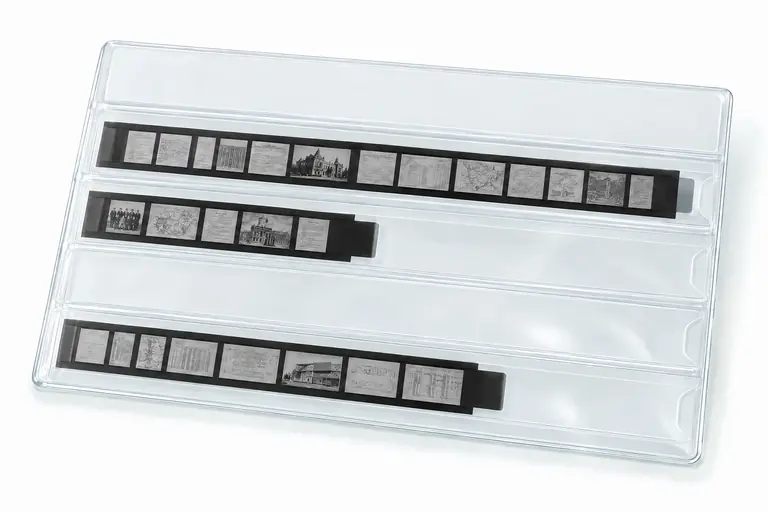
Jacket
A jacket is a transparent carrier with separate cut strips in channels, not two fiche sealed together.
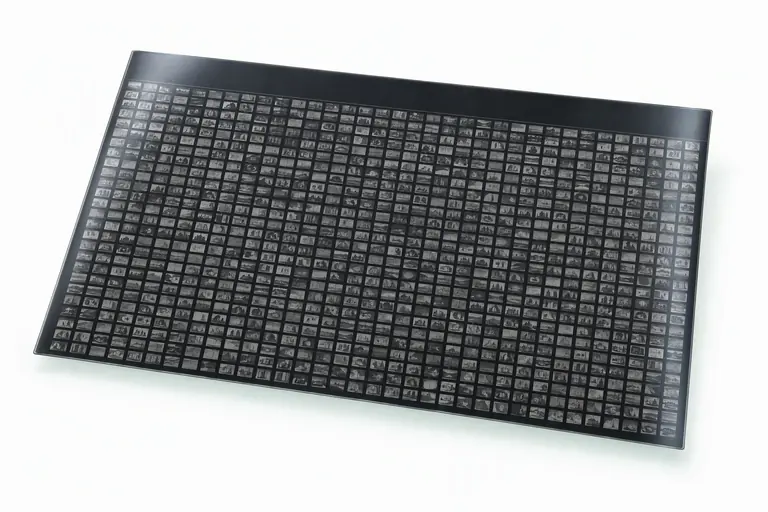
Ultrafiche
Ultrafiche is a high-reduction fiche format; it is not defined by card holes.
Same sheet. Different image density.
Separate carrier from image origin
Source-document, often called step-and-repeat, fiche is made by exposing separate document images directly onto fiche film. A useful frame reference may be a row and column plus source page number. Its header can carry valuable control information and should not be discarded from the collection context.
Jacket fiche is a carrier: a transparent plastic jacket with channels holding processed strips of cut roll film. A jacket is not necessarily a regular grid. Channels can have different strip lengths, empty positions, shifted strips, splices, or damage. The project record may need jacket, channel, strip, and frame references to preserve those relationships.
Recognize COM and ultrafiche patterns
COM means computer-output microfilm. Its images are produced by a recorder from computer-generated signals rather than photographed from a paper original. It may contain reports, lists, statements, or forms. Report title, run date, report period, batch, account range, fiche sequence, and frame number can be more helpful fields than a generic document title.
Ultrafiche is fiche reduced above 90:1. The Library of Congress notes that its ratios and grid patterns have not been standardized. A dense layout and tiny image area make it important to inspect representative sheets rather than infer capture or OCR behavior from the fiche’s physical size.
| Fiche type | What it describes | Useful inventory notes |
|---|---|---|
| Source-document | Direct document images on fiche | Header, grid, source pages, row/column |
| Jacket | Carrier holding strips | Jacket ID, channels, strips, frame ranges |
| COM | Computer-generated output on film | Report identity, period, sequence, frames |
| Ultrafiche | Reduction above 90:1 | Actual layout, sample legibility, nonstandard traits |
Read a grid as a map, not a promise
A common fiche sheet is approximately 105 × 148 mm and normally has a heading area above the image grid. FIPS PUB 54-1 documents legacy standardized layouts including 24/63, 24/98, 48/270, and 48/420. The names combine nominal reduction and capacity, making them useful identification references.
For example, a 24/98 layout has 14 columns by 7 rows, while a 48/270 layout has 18 columns by 15 rows. Those historic patterns do not prove that every fiche with a similar appearance follows the standard. Inspect actual row and column counts, frame boundaries, headings, and condition before using grid coordinates as a retrieval key.
Preserve a stable path from record to frame
An index can operate at more than one level: collection or series, fiche or jacket, and frame. For a gridded sheet, a row/column reference may be practical. For a jacket, channel and strip sequence can be essential. For COM, report-period and frame identifiers can reflect how users originally retrieved information.
Fictional example — no PII: “Fiche FIN-204, header ‘Monthly Ledger’, 15 × 18 grid, row 08 / column 12, report period 1987-04.” The example identifies a source position without assuming that all 15 × 18 grids are COM or that every file requires the same fields.
Go deeper on the material you have.
Detailed identification clues, capture considerations and retrieval questions for these formats.
Common questions
Does a 105 × 148 mm fiche always contain the same number of images?
No. Sheet dimensions do not establish grid, reduction, production method, or frame count.
Is jacket fiche a kind of COM?
No. Jacket describes a carrier with channels. COM describes computer-generated image production. A collection can use either or both concepts.
Are grid coordinates enough for an index?
They can be useful, but combine them with a fiche or jacket identifier and any record-specific fields users need.
Sources & further reading
These references explain technical formats, standards or destination requirements. They do not imply endorsement of National Microfilm.