
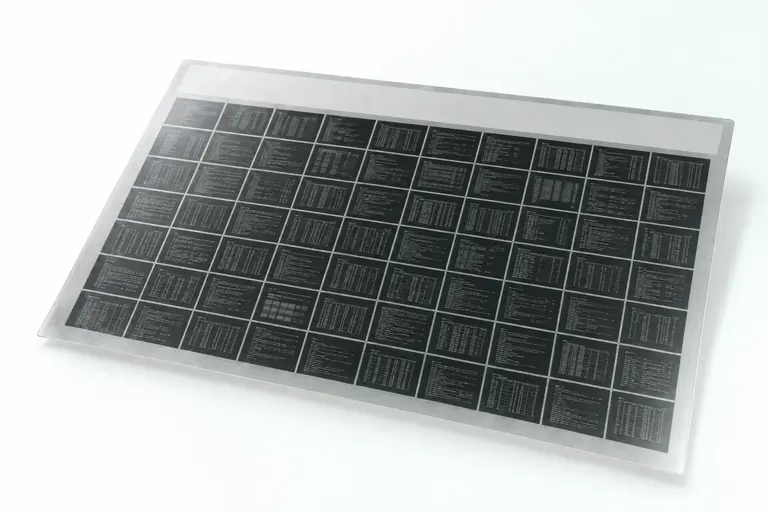
Recognize the format.
COM microfiche is a flat, grid-arranged microfiche whose images were recorded directly from computer output rather than photographed from paper documents.
- Readable heading names a system, report, date, or period.
- Dense, regular grid of report-style microimages.
- Documented or visible reduction and frame layout, when available.
COM microfiche: what to look for
Three useful notes for your project
- Record the header, fiche sequence, report or system title, and any run or period date.
- Note carrier, sheet dimensions, grid layout, stated reduction, and polarity separately.
- Keep order and associated labels; flag scratches, curl, dirt, or other condition concerns.
COM identifies the image source, not every physical trait
Computer-output microfilm (COM) is a technique for generating microforms directly from computer output, whether the recorder operates online or offline. COM microfiche is the flat fiche version of that output. COM does not mean a bibliographic catalog; it describes how the microimages were generated.
Do not let the word COM replace the physical description. Record the carrier as a fiche, its sheet dimensions, its grid or frame layout, its positive, negative, or mixed polarity, and its material only when that material is identified. These are separate dimensions, and a COM fiche can be a master, printing master, or service copy. A jacket is different: it is a carrier with channels holding cut strips, not a definition of COM.
Read the heading and grid before assigning a type
A microfiche is a transparent sheet of film with microimages in a grid and a heading readable without magnification. The Library of Congress describes a common COM fiche as a 105 × 148 mm sheet at an effective 48:1 reduction, with 15 rows and 18 columns for 270 microimages. That pattern is an identification clue, not a rule for every COM collection.
NIST’s historical FIPS standard also documents 48/270 and 48/420 formats. In that notation, the first number is the nominal reduction and the second is frame capacity. Other layouts, ratios, sheet sizes, orientations, or empty frames can occur. A report or system title, date, and fiche sequence in the heading often provide stronger retrieval evidence than a visual guess about the grid.
COM preserves computer-generated output as microimages
COM records data from electronic sources onto microfilm through a recorder and processing workflow. The resulting fiche may contain report pages, lists, statements, forms, or other computer-generated output. the film image may be the record available for scanning even when there is no corresponding paper original to compare against.
For capture planning, distinguish what is visibly present from what is assumed. A run date, report period, page number, form identifier, column headings, or control total may be visible in the header or frame. Reduction ratio is usually printed on the microform when known; when it is not, it cannot be reliably derived from the fiche alone without the original dimensions and microimage size.
Plan capture around the film image and legibility sample
Dense grids and small report type make a representative sample important. Focus, density, contrast, frame boundaries, scratches, curl, and the usable detail already present on the fiche all affect the result. A higher numeric scanner setting cannot recreate characters or column rules that were not resolved in the original microimage.
FADGI explains that microfilm is digitized at a fixed PPI relative to the film, regardless of the original reduction ratio. If known, the reduction ratio should be retained as metadata because it helps recover original scale. a scan setting is not, by itself, a guarantee of original-paper detail, legibility, or OCR results.
Use fielded indexing and OCR for different retrieval jobs
A COM index should preserve the route from a delivered image back to its fiche and frame. Useful fiche-level fields can include the header text, system or report title, run date, report period, fiche sequence, and visible range. Frame-level fields can include a page number, row and column, or another stable reference. OCR can add searchable text from printed characters, but it should not replace a required retrieval field.
Illustrative indexing example only: a frame could be identified as “Monthly inventory report | 1987-04 | fiche 003 | row 07, column 12 | printed page 118.” If an account, case, or other operational identifier is visibly present and approved for the project, it can be a separate source-linked field rather than an assumption from OCR. National Microfilm reviews sample-based scanning, indexing, OCR, and approved delivery scope for each collection.
Keep the fiche intact and bring questions to sample review
Keep fiche in existing order with headers, drawer labels, and any legacy report lists. Handle individual sheets by the edges with gloves and keep equipment and work surfaces clean. Do not use age or color to infer film base or chemistry. If a fiche is scratched, distorted, curled, or shows possible deterioration, document the observation instead of trying an unapproved repair or cleaning method.
For a sample review, ask: Does the header establish the report, date, and sequence needed for retrieval? Which frame details must remain readable at the intended use size? Should delivery retain one fiche-level reference plus row-and-column positions, visible page numbers, or both? Those questions turn the physical fiche into an agreed capture and indexing plan without promising that all frames or OCR will behave alike.
Common questions
What does COM mean on microfiche?
COM means computer-output microfilm: microforms generated directly from computer output. It does not by itself identify the fiche grid, polarity, film material, or generation.
Is every COM microfiche a 270-image fiche?
No. A 48:1, 15-row by 18-column, 270-image sheet is a common Library of Congress example, but COM fiche layouts and reductions can vary.
Can OCR replace a COM fiche index?
No. OCR can support search of readable printed characters, while structured fields such as report title, date, fiche sequence, and frame reference support dependable retrieval.
Can a COM fiche be identified from its color or age?
No. Color or age alone does not reliably establish the film base, emulsion, or production details. Record visible evidence and use collection documentation or specialist review when needed.
Sources & further reading
These references explain technical formats, standards or destination requirements. They do not imply endorsement of National Microfilm.
- NIST FIPS PUB 54-1: Computer Output Microfilm and Source Document Microfilming
- Library of Congress: MARC 21 Microform Format 007
- Federal Agencies Digital Guidelines Initiative: Technical Guidelines for Digitizing Cultural Heritage Materials
- National Archives: Film-Based Negatives and Positives
- Indiana Archives and Records Administration: Computer Output Microfilm
- NEDCC: Microfilm and Microfiche
- Library of Congress: Microfilm Selection for Digitization
- U.S. Government Publishing Office: Quality Assurance Through Attributes Program for Microforms