
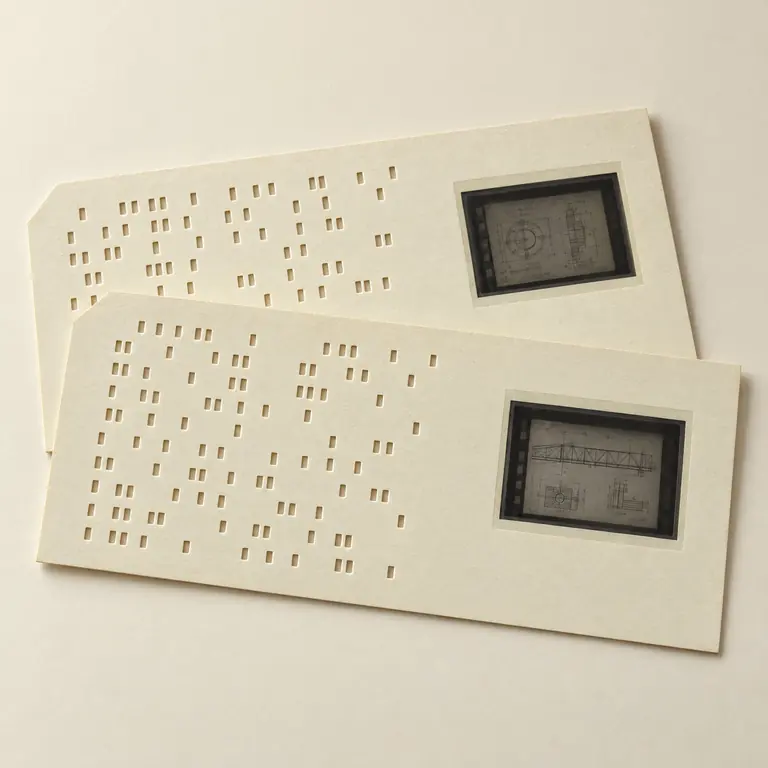
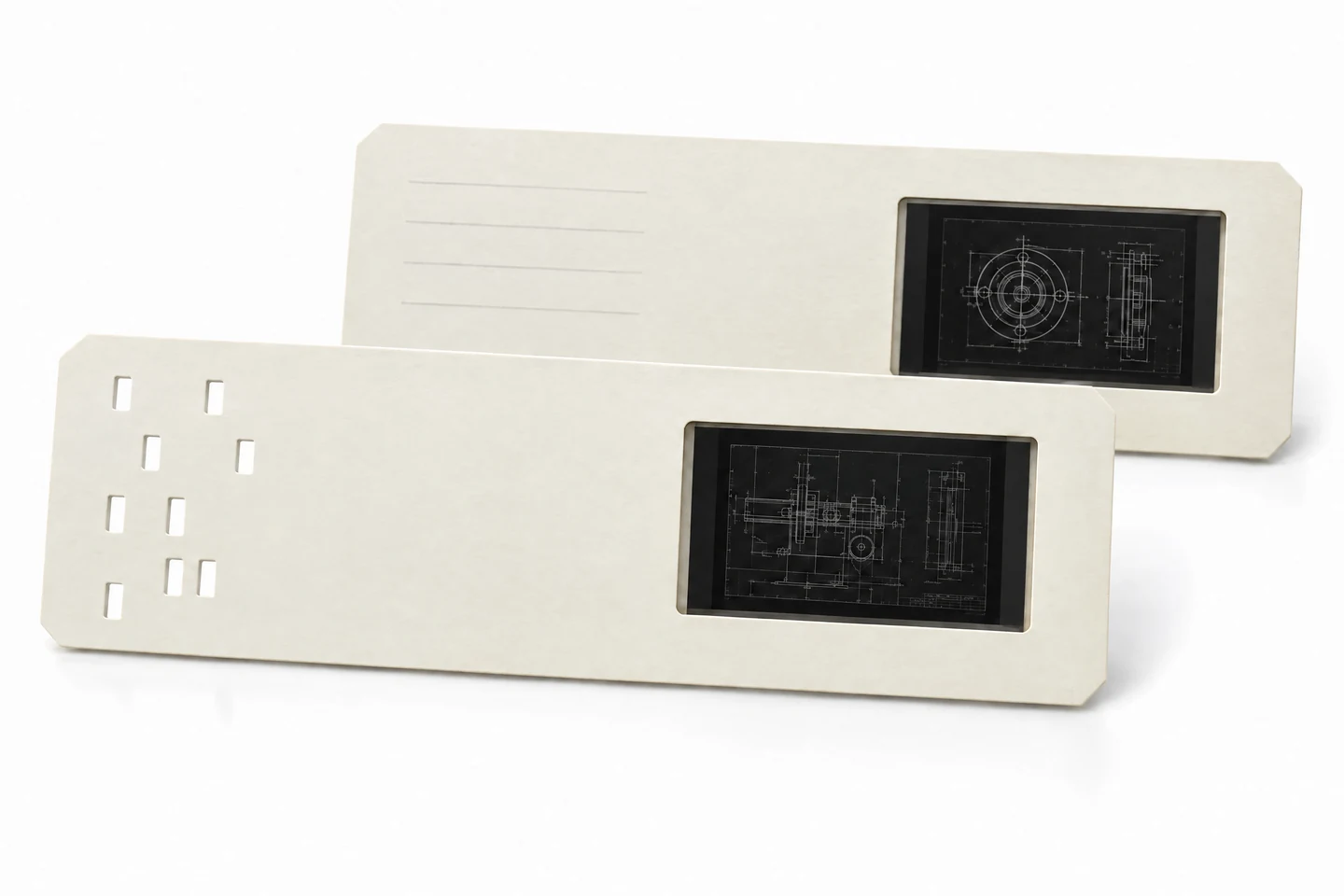
Punched or unpunched. Keep the drawing connected.
Both carry a mounted film image. The difference is where the record identifiers come from—not whether the drawing is valuable.
Encoded metadata
Rectangular holes may hold legacy identifiers. The local code map and a representative decoding check establish what those values mean.
Punched-card guideVisible source identifiers
Card labels, the drawing title block and an existing drawing register can supply fields such as drawing number, sheet and revision.
Unpunched-card guideScanning creates a raster image. OCR and indexing support retrieval; editable CAD is a separate requirement.
Raster scanning versus CADThe card and the image tell different stories.
Inspect card and film as related evidence
A common aperture card is an 80-column tabulating-size card carrying one 35 mm microfilm frame, but collections can include multi-aperture or atypical cards. The card can have printed labels, handwritten notes, a title reference, punched columns, or no visible metadata at all. The mounted film may have different polarity, density, condition, and fine-detail characteristics from card to card.
The desired output should state whether the card face, punch pattern, and film frame are retained as associated images or described in metadata. This preserves context for later retrieval and avoids treating the drawing image as though it were a free-standing paper scan.
Punched and unpunched cards use different routes
An 80-column format does not prove that a card is punched, and punched holes do not explain themselves. When the collection-specific code map is available, a sample can be compared with visible card text and any drawing register before decoded values are used in an index. The map used to derive a value should remain part of the project documentation.
Unpunched cards can still be highly retrievable. Drawing number, sheet, revision, title, location, discipline, and issue date may be visible on the card or within the drawing title block. OCR can assist extraction, while ambiguous values can be handled through an agreed review or exception process.
A scan is raster, not editable CAD
Scanning an aperture-card film frame creates a raster image made of pixels. It can support display, zooming, printing, OCR, and indexing, but it does not automatically create editable lines, layers, measurements, or engineering objects. CAD files use vector geometry and preserve functions that a flattened bitmap does not.
Raster-to-vector tracing or CAD redrafting is a separate conversion activity. If it is needed, the specification must define the requested deliverable, scale assumptions, layers or attributes, source condition, and review criteria. Existing born-digital CAD files, where present, should be handled as their own files rather than assumed to be replacements for the card image.
Fine-line drawings deserve sample-based decisions
Dimension lines, hatching, small lettering, low contrast, and film condition can change what is legible at the intended viewing size. National Archives guidance recommends testing actual engineering-drawing samples when determining appropriate imaging resolution. One fixed resolution is not a reliable claim for every card collection.
A useful project brief includes card count, whether cards appear punched, available drawing registers, expected index fields, visible multi-aperture cards, and the delivery use case. National Microfilm can review raster capture, structured indexing, OCR support, and customer-defined delivery requirements for the collection.
Public-works drawing archives: plan the evidence, not just the image
Engineering collections can contain aperture cards, roll-film drawings, maps, plats and registers. Identify the actual media rather than assigning every drawing to one format. Where your organization controls the collection, available card labels, title blocks and registers can help define drawing number, sheet, revision, title and source-card references. Those fields are collection-specific; a generic punch pattern does not establish their meaning.
For multiple images inside one aperture or multiple apertures on one card, decide whether the output should retain the whole card context, separate record images, or both. Assign stable references so separated images do not lose their relationship to the card. Sample review should address fine lines and title-block legibility. Digitizing a drawing produces a raster record, not editable CAD geometry, and does not establish rights to release infrastructure plans.
- Reconcile proposed identifiers against the available register or source evidence.
- Agree full-card versus separated-image output and source-card relationships.
- Define exception handling and customer-approved repository fields before delivery.
Technical references:[4]
Go deeper on the material you have.
Detailed identification clues, capture considerations and retrieval questions for these formats.
Common questions
Does every aperture card contain a punched index?
No. A standard 80-column card can be punched or unpunched, and a punch layout needs its local code map before it can be interpreted.
Will scanning convert drawings to CAD?
No. A scan is raster capture. Vectorization or CAD redrafting is a separately specified conversion activity.
What fields can be indexed?
Where present and approved, fields can include drawing number, sheet, revision, title, location, discipline, source card ID, and image reference.
Sources & further reading
These references explain technical formats, standards or destination requirements. They do not imply endorsement of National Microfilm.