
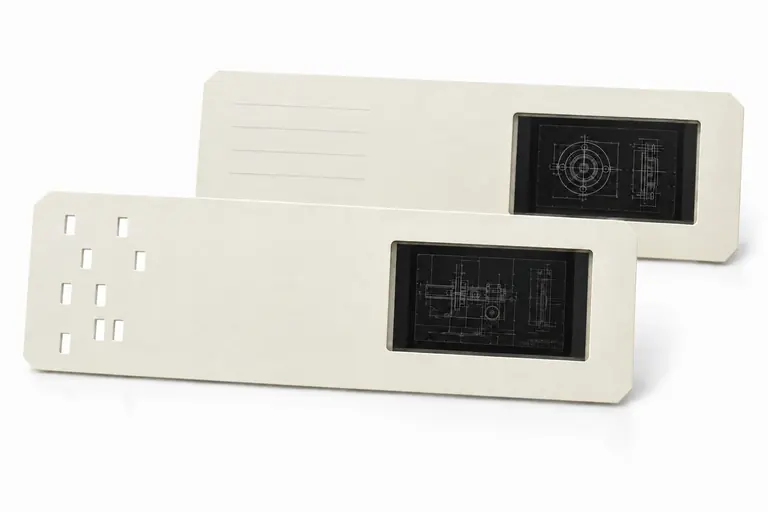
Recognize the format.
Aperture cards with a mounted microfilm image and punched tabulating positions that may encode retrieval metadata when a code map is available.
- Card-sized carrier with a rectangular film aperture
- Rows of small rectangular punches in the card body
- Mounted microfilm frame, commonly 35 mm
Hollerith-punched aperture cards: what to look for
Three useful notes for your project
- Whether a punch-code map, card layout, or drawing register survives
- Card dimensions, aperture count, visible labels, and punched or unpunched status
- Film polarity, image condition, and representative fine-line detail
Identify the card before interpreting the punches
A Hollerith-punched aperture card has holes in its tabulating area that can represent coded characters or values. NARA describes the common form as an 80-column paper card with an aperture containing one 35 mm microfilm frame, often for engineering drawings, maps, charts, and X-rays. The Library of Congress also documents cards with one or more rectangular openings.
Record attributes separately: carrier, aperture count and mounted-film width, punches, polarity, and—when known—emulsion, base, and generation. A rectangular aperture plus regular small rectangular punches identifies the form, not what those punches mean.
What Hollerith punching can—and cannot—tell you
Federal Hollerith coding uses 12 rows; a pattern in one card column represents a character. It does not identify local fields such as drawing number, sheet, or revision. A register, punch-code specification, or tested sample links holes to usable metadata.
These cards suit drawing collections because one carrier can hold a microfilm image and machine-readable data. Unpunched cards may still have useful labels. Punching is an indexing characteristic, not a measure of image quality or importance.
Capture the film image and card context
Aperture-card work is transmitted-light film capture, not simply paper scanning. Fine dimension lines, hatching, small title-block text, density range, focus, scratches, polarity, and the original reduction can affect what remains legible. FADGI notes that transparency film can have a wide density range that challenges capture optics and sensors. National Archives guidance also calls for testing actual engineering-drawing samples when determining resolution for fine-line material.
Define whether the project needs the full card face, the punch field, the film frame, or associated images of each. Keeping an image or documented reference to the card alongside the drawing can preserve labels and the pattern needed for future decoding. no single scanner setting proves that every fine line or title-block character in a collection will be readable.
Decode, index, OCR, and choose outputs separately
Start with the authoritative register or code map when available. Reconcile a representative decoded sample against visible card printing and the drawing title block before applying it at scale. Illustrative mapping only: a project could document columns 1–10 as drawing ID, 11–13 as sheet, and 14–15 as revision, then store the code-map version and a source note such as “punch decode,” “card label,” or “title block review” with every value. Do not assign those field meanings without the collection’s evidence.
OCR can support finding printed labels or title-block text, but it is not a substitute for a verified index or the visual drawing image. In searchable-PDF workflows, NARA accepts OCR only when it does not replace, alter, or degrade the original bitmap image. Plan a raster master or production image, an access derivative suited to users, and a structured index as distinct deliverables. Scanning creates raster pixels; it does not turn drawing lines into editable CAD geometry.
Prepare cards without altering their evidence
Keep cards in existing sequence with their drawer, box, or register references. Note bent cards, loose or damaged film mounts, rubbed labels, mixed punch patterns, visible multi-aperture cards, and image-condition concerns without trying to repair, repunch, erase, trim, or write on the cards. The sample should retain representative variations, not just the cleanest-looking cards.
Handle the mounted film by its edges and keep capture surfaces clean. The National Archives advises edge handling with gloves for microforms and recommends preservation guidance for deteriorated microforms or uncertain treatment. Do not infer emulsion, base, or generation from a card’s age or color; record them as unknown unless supported by inspection records or reliable identification.
Questions to settle in a sample review
A sample review should ask: Are cards consistently punched, and does a register or code map survive? Is the mounted image positive, negative, or mixed? Are there single- and multi-aperture configurations? Which card labels, title-block fields, and punch-derived fields must be retrievable? What exceptions—missing images, duplicate cards, or unreadable labels—need a documented status?
Share representative front and back card photographs, several film-image samples, available registers, a count by box or drawer, and the desired retrieval outcome. National Microfilm reviews sample-based scanning, indexing, OCR, and approved delivery scope with the physical collection and its available documentation. That review can define what evidence is captured, how fields are validated, and which output roles support the intended use.
Common questions
Are all 80-column aperture cards Hollerith-punched?
No. An 80-column card is a physical tabulating-card format. The card must be inspected for actual punches, and the punch pattern still needs an applicable code map before it is interpreted.
Do punched holes always contain a drawing number?
No. Hollerith punching can encode characters, but the field meaning is defined by the originating collection’s layout or register. Verify a sample against visible evidence before using decoded values.
Can OCR replace punch decoding or manual indexing?
No. OCR can assist with printed card labels and title-block text, but it can be limited by image quality and does not explain a local punch layout. Use source-linked index fields for identifiers that must be retrieved reliably.
Does aperture-card scanning create CAD files?
No. Scanning produces a raster image of the microfilmed drawing. Vectorization or CAD redrafting is a distinct, separately defined conversion activity.
Sources & further reading
These references explain technical formats, standards or destination requirements. They do not imply endorsement of National Microfilm.
- National Archives: Specific Media Type Authority List
- Library of Congress: MARC 21 Bibliographic 007 Microform
- NIST FIPS PUB 14-1: Hollerith Punched Card Code
- IBM: History of the Punched Card
- FADGI: Technical Guidelines for Digitizing Cultural Heritage Materials
- National Archives: Digital Imaging and Storage
- National Archives: Appendix A Tables of File Formats
- Library of Congress: Still Image Quality and Functionality Factors
- National Archives: Film-Based Negatives and Positives