
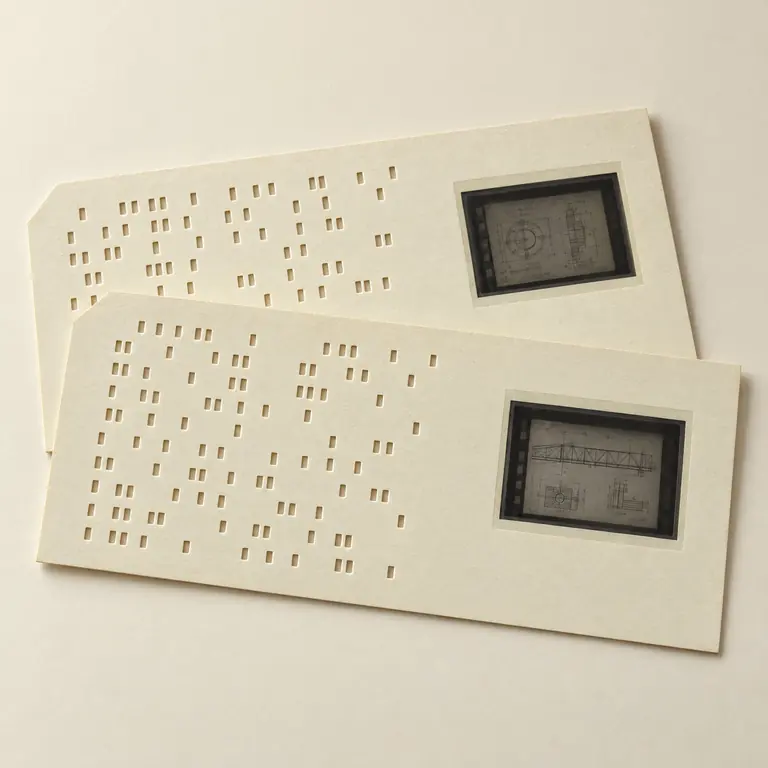
Punched or unpunched. Keep the drawing connected.
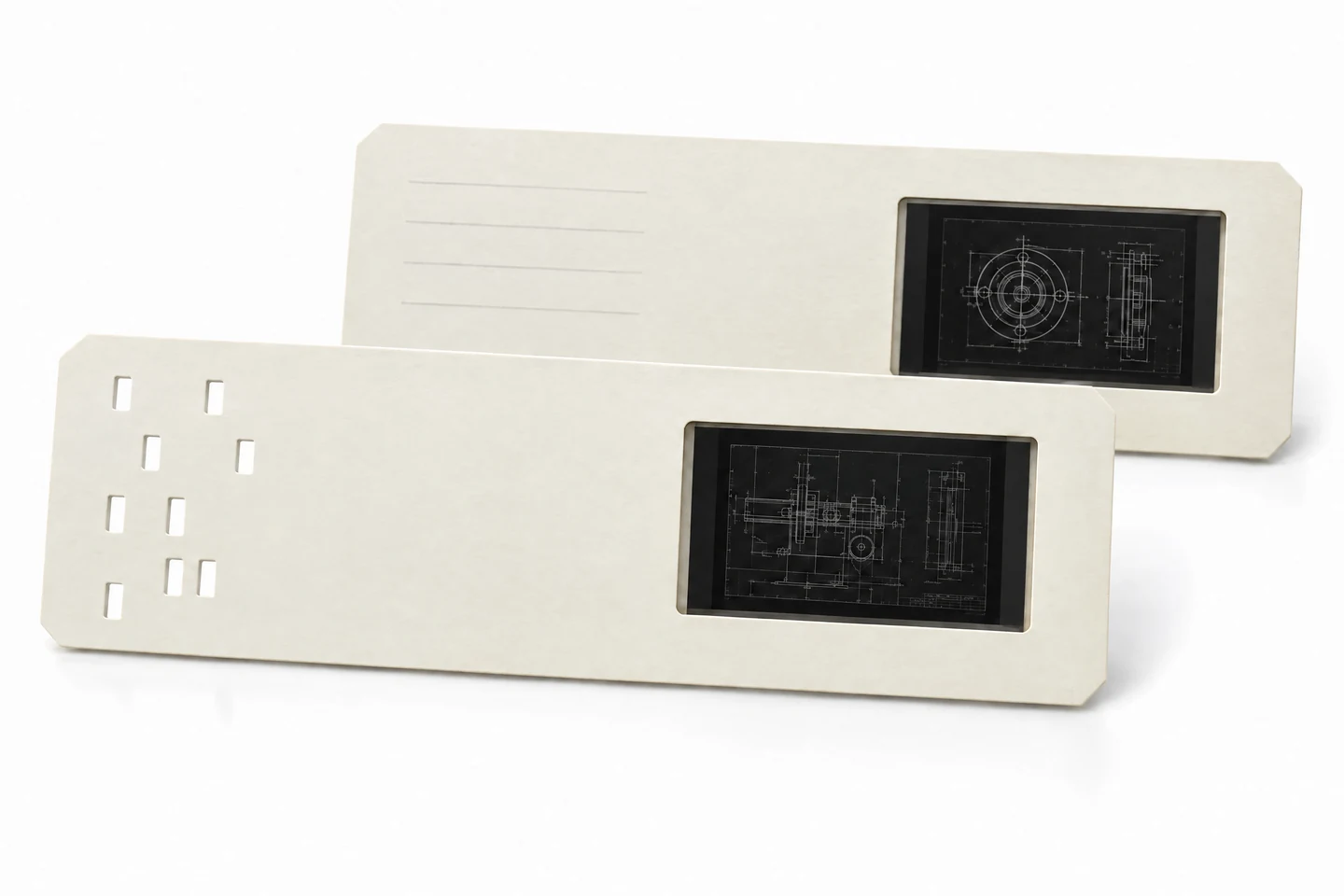
Both carry a mounted film image. The difference is where the record identifiers come from—not whether the drawing is valuable.
Encoded metadata
Rectangular holes may hold legacy identifiers. The local code map and a representative decoding check establish what those values mean.
Punched-card guideVisible source identifiers
Card labels, the drawing title block and an existing drawing register can supply fields such as drawing number, sheet and revision.
Unpunched-card guideScanning creates a raster image. OCR and indexing support retrieval; editable CAD is a separate requirement.
Raster scanning versus CADThe card and the image tell different stories.
Understand the 80-column context
National Archives catalog guidance describes a common aperture card as an 80-column tabulating-size card holding one 35 mm microfilm frame. The format is often associated with engineering drawings, maps, charts, and X-rays. Other card forms, including cards with multiple apertures, can occur and should be identified before a batch is treated as standard.
The 80-column description does not establish that a card is punched or that holes encode a universal index. Historical punched-card systems use columns and hole positions to represent data, but a local implementation determines which columns mean drawing number, revision, location, or another value.
Decode only with the relevant map
A punched card has perforations in its tabulating area that may encode identifiers or other legacy metadata. Where an originating code map and a compatible decoding process are available, the most useful practice is to test a representative sample against visible card text and any existing drawing register. Keep the code-map version as provenance for decoded fields.
Without a code map, holes are evidence that a coded system existed; they are not self-explanatory metadata. It is safer to preserve a card image or punched-status indicator and rely on visible labels or external registers than to invent a column interpretation from a generic Hollerith chart.
Visible evidence can still form a strong index
An unpunched card has no hole-coded data to decode, but it may have detailed visible information. Printed card text and the drawing title block can provide drawing number, sheet, revision, title, location, project, equipment reference, or date. An existing drawing register may provide another authoritative source for validation.
OCR can help surface typed or printed characters from labels and title blocks. It should be treated as an extraction aid, not the only proof of a critical identifier. Unclear values can be tagged for review, with a source field such as card label, title block OCR, manual review, or existing register.
| Evidence | Useful handling |
|---|---|
| Known punched code | Sample decode, validate, store code-map provenance |
| Unknown punched code | Record punched status; do not assume meanings |
| Printed card label | Transcribe or OCR-assist; retain card association |
| Drawing title block | Capture available fields; flag ambiguity |
| Drawing register | Use as an authoritative comparison where approved |
Build an index that retains its source
Possible fields include collection or box identifier, unique card identifier, drawing number, sheet number, revision, title, discipline, location, capture filename, and exception notes. The specific fields should follow the customer’s retrieval needs and available evidence, not a generic aperture-card template.
Fictional example — no PII: `drawing_number=DWG-0319`, `revision=C`, `source=card label`, `punch_status=present`, `punch_map=unknown`. This preserves useful facts while preventing an undocumented punch pattern from being represented as decoded data.
Go deeper on the material you have.
Detailed identification clues, capture considerations and retrieval questions for these formats.
Common questions
Does an 80-column aperture card always have punched data?
No. It can be punched or unpunched. The 80-column form alone does not establish the presence or meaning of encoded metadata.
Can a generic punch chart decode my cards?
Not reliably. Use the originating collection’s documented code map and validate a sample against visible or register data.
What if labels and a drawing register disagree?
Record the source of each value and route the discrepancy through the project’s agreed exception process.
Sources & further reading
These references explain technical formats, standards or destination requirements. They do not imply endorsement of National Microfilm.