
Recognize the format.
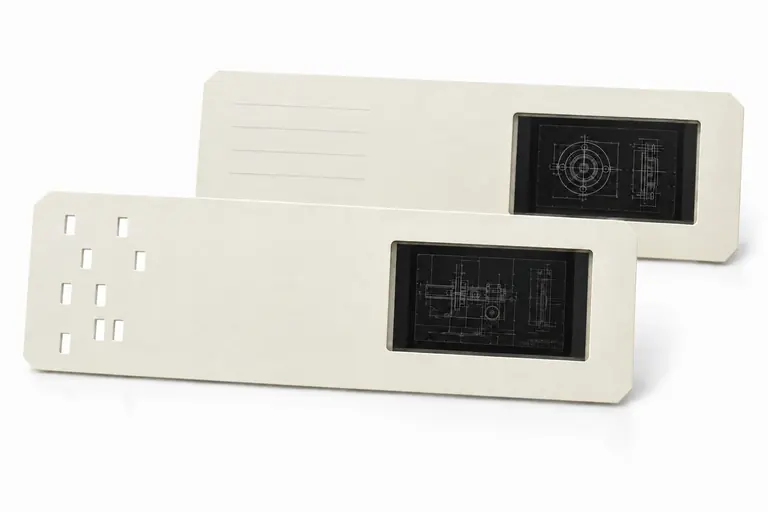
An unpunched aperture card has a mounted microfilm frame but no hole-coded metadata to decode, so identification begins with visible labels and related finding aids.
- No punched holes across the tabulating area.
- A rectangular aperture holds a microfilm frame.
- Visible label text may appear on the card face.
Unpunched aperture cards: what to look for
Three useful notes for your project
- Photograph or scan both card faces when their labels are needed.
- Note aperture count, film polarity, and insert condition.
- Provide any drawing register, file list, or legacy index.
Definition and identification
An unpunched aperture card has no perforated, machine-readable punch pattern in its tabulating area. “Unpunched” is a metadata attribute, not a film chemistry, width, polarity, or generation. The mounted image can be positive or negative, and aperture count and labeling can vary.
NARA describes the common form as an 80-column tabulating-size paper card with one 35 mm microfilm frame. This is an identification baseline, not a rule for every collection: the Library of Virginia allows one or more rectangular apertures holding one or more frames. Inspect the card rather than relying on a drawer label.
What the card can show—and what it cannot
Aperture cards commonly carry engineering drawings, maps, charts, and X-rays. The aperture holds the microfilm image, while the paper card may carry typed, printed, stamped, or handwritten context. With no punch pattern to interpret, visible card text, title-block text, and a drawing register are the practical indexing evidence. No punches does not mean no identifier or lower image quality.
Capture the aperture image, then test fine detail
Aperture-card scanning creates a raster image of the filmed drawing, not an ordinary paper-page scan. Small title-block text, dimension strings, faint lines, dense areas, cropped edges, and polarity can limit legibility. A card-face image preserves label context; the aperture image preserves the drawing. NARA advises case-by-case testing for drawings and fine-line material, while FADGI explains that microfilm is sampled at a fixed PPI relative to the film. If no reduction ratio or scale is available, original-document scale may be lost; sharpening cannot recreate detail absent from the film.
Index visible evidence and treat OCR as assistance
Without punches, start with the most authoritative evidence: a drawing register or file list, then card-face and title-block text. Useful fields include collection or box ID, card ID, drawing number, sheet, revision, title, date, location or discipline, and a source note such as “card label,” “title block,” or “existing register.”
Illustrative indexing example only: `Collection BX-4 | Card 004218 | Drawing 127-04 | Sheet 2 of 5 | Rev C | Source: card label and title block`. OCR can propose printed text but needs review for reliable retrieval fields. A raster production master can support derivatives; a searchable PDF should retain the original bitmap image. A scan is not editable CAD geometry.
Prepare the collection without changing the evidence
Keep cards in order and retain drawer labels, dividers, and registers. Document a representative set of both faces, including labels, aperture count, and condition. If an apparently unpunched batch contains occasional punches, flag and segregate that exception for its own indexing decision.
Handle mounted film by its edges with clean gloves and keep equipment clean. Set aside loose inserts, tears, scratches, distortion, or deterioration concerns rather than repairing or detaching the film. Do not infer film base or chemistry from age or color; NARA notes that support dates overlap and date alone is unreliable.
Technical references:[6]
Questions to settle in a sample review
Are all cards unpunched, and do any use more than one aperture? Which labels need image capture, and which fields need indexing? Is a register available to validate drawing number, sheet, or revision? Are title blocks legible at the intended access size? Which output needs the full raster image, an access derivative, OCR text, or a fielded index? The answers define approved scanning, indexing, OCR, and delivery scope without mistaking a blank punch area or OCR result for missing evidence.
Common questions
Do unpunched aperture cards have metadata?
They can. There is no hole-coded metadata to decode, but visible card labels, a filmed title block, and a drawing register or file list may supply index evidence.
Can OCR replace an aperture-card index?
No. OCR can assist with printed label and title-block text, but fine lines, small characters, poor focus, density variation, and image damage can limit results. Validate important retrieval fields against visible evidence or a register.
Does scanning an aperture card create a CAD file?
No. Scanning creates a pixel-based raster surrogate. CAD files are vector graphics built from mathematical expressions, so vectorization or CAD redrafting is a separately defined activity.
Sources & further reading
These references explain technical formats, standards or destination requirements. They do not imply endorsement of National Microfilm.
- National Archives Specific Media Type Authority List
- Library of Virginia Guidelines for Microfilming Records
- IBM History of the Punched Card
- National Archives Digital Imaging and Storage Report
- FADGI Technical Guidelines for Digitizing Cultural Heritage Materials
- National Archives Film-Based Negatives and Positives
- National Archives Guidelines for Digitizing Archival Materials for Electronic Access
- National Archives Appendix A Tables of File Formats