
Microfilm, microfiche or aperture card?
These family names describe different physical carriers. The details beneath each family help establish what is in a collection before planning a scan or index.
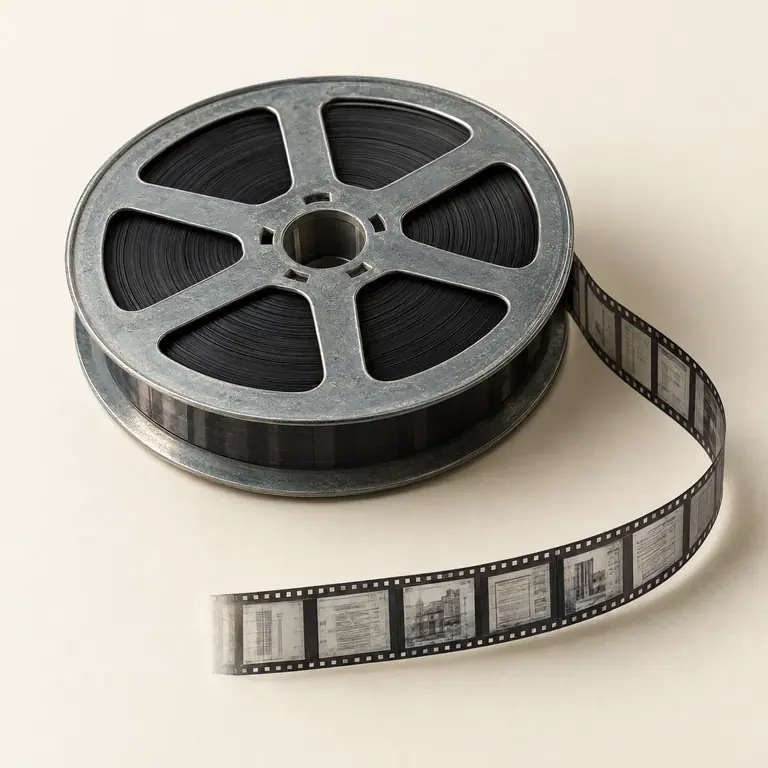
Microfilm
Film held on a reel or within a carrier, arranged as a continuous sequence of images.
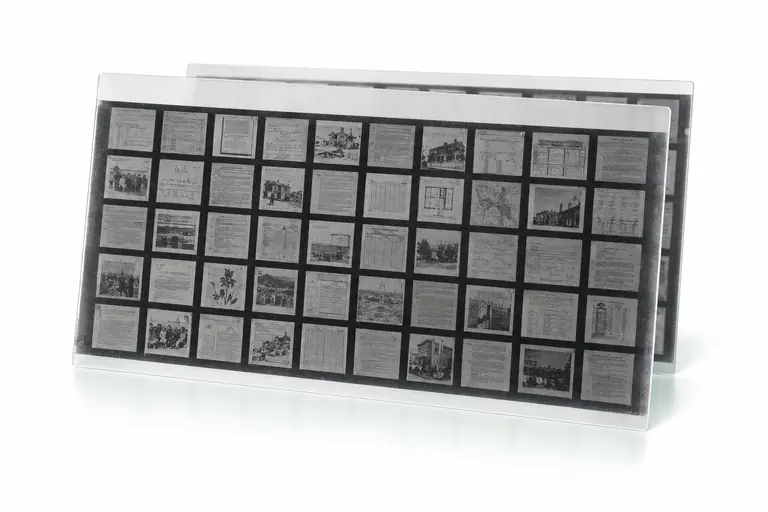
Microfiche
A flat sheet with a header and grid, or a transparent jacket carrier holding film strips in channels.
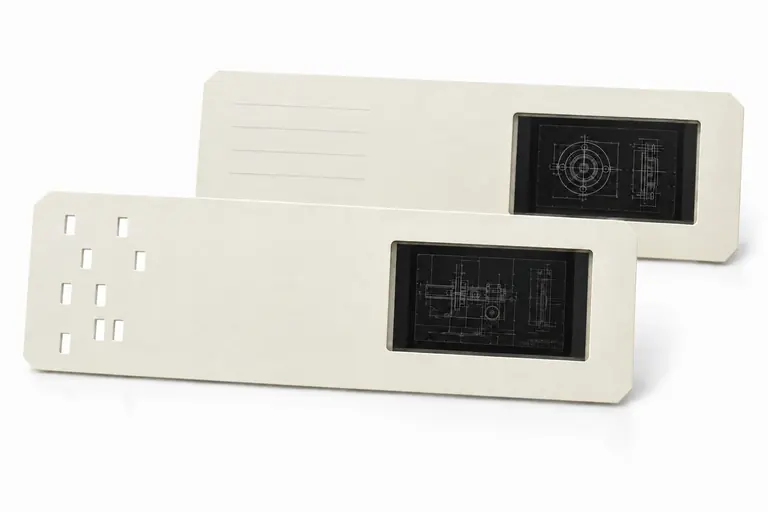
Aperture card
A card carrying a mounted microfilm frame, often used with drawing or engineering records.
Use the carrier-first test
Microfilm is roll-form film with images in sequence. An open reel has flanges around wound film; a loose roll is wound film without a reel; a cartridge houses film on a single hub; and a cassette encloses film on two cores. These names matter because loading and access are not the same for every carrier.
Microfiche is a flat transparent sheet with a readable heading area and a two-dimensional image grid. Jacket fiche is a transparent plastic carrier with channels holding cut strips of roll film. An aperture card is a card with one or more apertures holding microfilm; a common form carries a 35 mm frame and appears frequently in engineering, map, chart, and X-ray collections.
| If you see… | Likely term | Record this detail |
|---|---|---|
| Wound film on flanges | Reel | Film width, reel/core, labels, targets |
| Film in a protective single-hub case | Cartridge | Carrier type, labels; do not remove for identification |
| Flat grid with a heading | Microfiche | Sheet size, header, grid, reduction if marked |
| Plastic channels holding strips | Jacket fiche | Jacket ID, channel count, strip sequence |
| Card holding film aperture | Aperture card | Aperture count, punched status, card text |
Put dimensions in context
The Library of Congress identifies 16 mm and 35 mm as common microfilm widths. Those measurements describe the film itself, not a universal document type or the size of the original paper. A label reading 16 mm should be recorded alongside carrier form, layout, polarity, and any known reduction ratio.
A common microfiche sheet is approximately 105 × 148 mm. The number 105 mm needs context: it commonly describes a fiche dimension, while cataloging vocabularies can use dimensions in other ways. Write “105 mm microfiche” when the object is a fiche sheet rather than assuming that “105 mm film” names its carrier.
Note visual clues without overdiagnosing
Polarity describes tonal direction: positive images have dark information on a light background, while negative images have light information on a dark background. A collection can be mixed. Simplex and duplex describe one-up or two-up filming layout; they do not mean a paper scanner’s front-and-back setting. Cine and comic describe orientation on roll film.
Image marks, sometimes called blips, can help a legacy system count or locate frames. They are not the underlying document image and their meaning varies by collection. Record their presence and placement rather than assuming that every mark supplies usable document boundaries.
Create an identification note that is useful later
For each homogeneous batch, write down carrier, measured width or sheet dimensions, labels or targets, polarity, layout, reduction when known, condition observations, and intended use. Photographing or transcribing labels can be useful, provided the collection’s information-sharing rules allow it. Do not infer base, emulsion, generation, or deterioration diagnosis from age alone.
Fictional example — no PII: “Drawer B, jacket fiche, visible header ‘Series 4’, six channels, mixed strip lengths, two empty channels, negative polarity, reduction not marked.” This is more actionable than “old microfilm” because it separates observable facts from unknowns.
Go deeper on the material you have.
Detailed identification clues, capture considerations and retrieval questions for these formats.
Common questions
Is a microfiche just a small piece of microfilm?
Both are microforms, but fiche is a flat sheet with a grid while microfilm is generally roll-form. A jacket fiche also has channels holding film strips.
Does 16 mm tell me the original paper size?
No. It identifies a film width; source document sizes and reduction can vary.
Can I identify film type from a box date?
No. Dates can overlap among film supports and generations. Treat age as a clue to investigate, not a material diagnosis.
Sources & further reading
These references explain technical formats, standards or destination requirements. They do not imply endorsement of National Microfilm.