
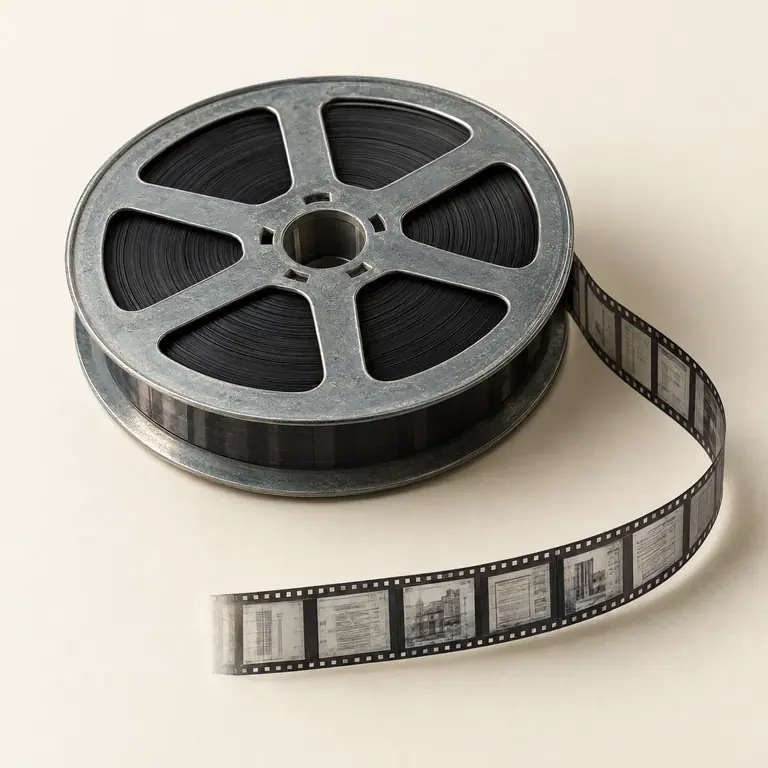
Recognize the format.
Roll microfilm with small rectangular optical marks in a dedicated channel used by compatible systems to count or locate image frames.
- Small rectangular optical marks repeat in a channel above or below the frame area.
- The marks sit apart from the photographed document image on a microfilm roll.
- Mark size or sequence may change at file, document, or page boundaries.
Blipped microfilm and image marks: what to look for
Three useful notes for your project
- Presence, position, and continuity of the mark channel across a representative sample.
- Any reader or system documentation that explains mark levels, sequences, or retrieval behavior.
- Roll carrier, width, polarity, reduction, orientation, targets, and visible condition.
What blipped microfilm is and how to identify it
A blip is an optical mark, usually rectangular, in a designated channel above and/or below the image area on roll microfilm. The U.S. Government Publishing Office says image-mark retrieval systems use it to automatically count or locate frames. “Document mark” and “blip mark” are earlier names.
Inspect a representative run in suitable viewing equipment. Look for a separate strip of short rectangles alongside frames, not text or graphics photographed from the source document. A blip is a retrieval attribute, not a film width, carrier, layout, polarity, reduction, emulsion, base, or generation.
What mark patterns can and cannot tell you
A compatible reader can use image marks for navigation. Some computer-output microfilm (COM) workflows used multi-level coding: a recorder exposed differently sized rectangles beneath pages, and a larger mark could designate the first page while smaller marks identified supporting pages.
That is a production convention, not a universal decoding key. Confirm mark position, size, count, and meaning against a target, reader documentation, existing index, or representative sequence. Do not treat every rectangle as a page or case number, or proof that a roll is COM. COM means computer-output microfilm; blips are a retrieval feature.
Capture and quality issues to review before production
Because blips can be sequencing evidence, decide in sample review whether the approved capture must retain the mark channel, the document frame, or both. A page-reading crop can omit the channel; a master or reference image may need it. Make that choice explicit rather than relying on a scanner default.
Review mark continuity, separation from frames, focus, density, scratches, splices, and polarity. FADGI says microfilm is digitized at a known PPI relative to the film, not automatically at original-paper size. Sample testing is needed; neither a setting nor a blip pattern guarantees readable detail or OCR.
Use blips for navigation, then design indexing and OCR separately
A blip becomes navigation metadata only when its local convention is documented; it is not the document’s descriptive index. Build fields from visible targets, labels, source pages, and authoritative finding aids. Retain the roll identifier and stable image or document sequence for traceability. OCR separately converts visible raster text into searchable text and needs sample testing.
Illustrative example: after a sample establishes that a large mark begins a document and smaller marks identify supporting pages, an index could record “Roll R-014, document sequence 42, images 001–004,” then add a verified identifier and date from the target or pages. OCR can support discovery, but should not replace the captured image or a must-find index field.
National Microfilm can review representative material to define a sample-based scanning, indexing, OCR, and approved delivery scope, including whether mark-channel reference images are needed.
Prepare blipped rolls without changing the evidence
Keep roll order, container labels, leader/trailer targets, indexes, and retrieval notes with the material. Record carrier and width separately from marks, then note channel position, apparent levels or interruptions, orientation, polarity, known reduction, and visible condition. Do not infer film base or emulsion from age or color.
Handle microfilm by the edges with gloves and keep equipment clean. Flag breaks, distortion, odor, abrasion, or redox blemishes for assessment rather than attempting repair. Do not dismantle a cartridge or cassette to inspect marks; compatible equipment or preservation guidance may be needed.
Questions to bring to a sample review
Include consecutive documents, an available target or label, and an example of any mark-pattern change. Confirm the relationship between marks, frames, document boundaries, and the intended search path before applying rules across a roll.
- Are marks above, below, or on more than one side, and are they continuous?
- What evidence explains each mark level or sequence?
- Should approved capture retain the channel, frame, or both?
- Which fields need visual verification instead of OCR alone?
- Do changes in reduction, layout, polarity, condition, or orientation need separate rules?
Common questions
What is a blip mark on microfilm?
A blip mark, now commonly called an image mark, is a usually rectangular optical mark in a dedicated channel above or below the image area on roll microfilm. Compatible systems can use it to count or locate frames.
Are blip marks part of the photographed document?
No. A blip is a separate optical retrieval mark, not an image of the underlying page. It can be sequencing evidence, so whether to retain it should be decided during sample review.
Do all blip patterns mean the same thing?
No. Multi-level coding can assign larger and smaller marks to document and supporting-page boundaries, but the local pattern must be verified from the roll, targets, reader documentation, or a trusted index.
Do blip marks make microfilm OCR accurate?
No. Blips help navigate frames, while OCR reads visible text. OCR depends on the microfilm image and processing, so representative samples should be tested before it is included in an approved scope.
Sources & further reading
These references explain technical formats, standards or destination requirements. They do not imply endorsement of National Microfilm.
- U.S. Government Publishing Office: Quality Attributes for Microforms
- New Mexico State Records Center and Archives: 1.14.2 NMAC
- FADGI: Technical Guidelines for Digitizing Cultural Heritage Materials
- National Archives: Film-Based Negatives and Positives
- Library of Congress: MARC 21 Bibliographic 007 Microform