
Read film clues as separate attributes
Width, carrier, layout and polarity answer different questions. Keeping them separate creates a clearer description of the material in front of you.
Width
16mm and 35mm describe measured film width, not a paper size.
Carrier
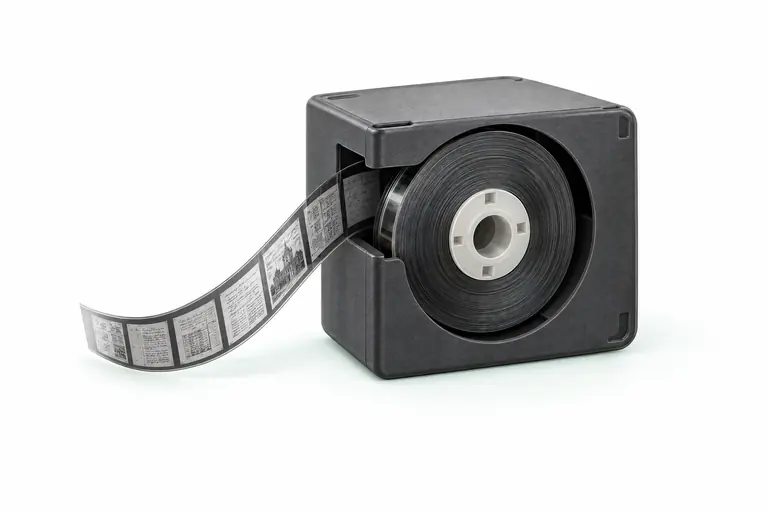
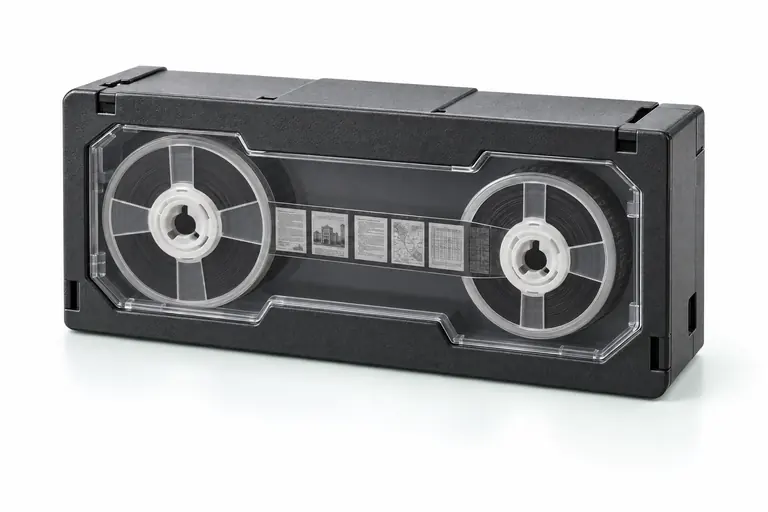
A cartridge has one hub; a cassette encloses two cores.
Layout
Simplex is one-up and duplex is two-up; this does not mean paper front and back.
Simplex and duplex guidePolarity
Positive has dark text on a light background; negative reverses that relationship.
Positive and negative guide
Blips or optical marks
Marks can appear as distinct rectangles along a film edge. Their meaning is collection-specific.
Blipped film image marks guideWidth is a physical attribute
The Library of Congress describes 16 mm and 35 mm as common widths for reels holding textual and graphic material. Because the number is a measurement of the film, it should be captured from the physical item or reliable collection documentation. It is not evidence that the source was letter-size paper, a particular record series, or a specified digital output.
In practice, 16 mm is often encountered with smaller business or public-record documents, while 35 mm is often encountered where a larger image area is useful. That is a practical pattern rather than a classification rule. A 35 mm roll can contain varied records, and a 16 mm roll can have its own reduction, orientation, and condition issues.
Read layout separately from width
Simplex means one page image is filmed at a time; duplex means two pages are filmed at a time. Those terms describe the layout on film, not the two-sided scanning of paper. Cine orientation places text perpendicular to the film length, while comic orientation places text parallel to it. Both can affect frame detection and the way a user views a derivative.
Frame navigation may also reflect targets, splices, blank sections, or image marks. A blip is an optical mark used by a retrieval system; it is not necessarily an index field. Record what is present instead of treating all roll film as a uniform sequence of identical pages.
| Attribute | Why it matters |
|---|---|
| 16 mm or 35 mm | Physical film width and compatible equipment context |
| Simplex or duplex | One-up or two-up image layout |
| Cine or comic | Orientation and viewing/frame-detection context |
| Reduction ratio | Historical capture scale, not a scan-setting instruction |
| Polarity | Preview, exposure, processing, and review context |
Reduction ratio is capture history
A reduction ratio compares the original document’s dimensions with the microimage. At 24:1, the film image is approximately one twenty-fourth of the original’s linear size. The ratio may be on targets or collection documentation; if it is absent, it cannot reliably be reconstructed from width alone because both original-document dimensions and image size are needed.
National Archives census materials provide examples of 16 mm and 35 mm reels with reductions from 12.1:1 to 20.1:1. They are examples from a defined program, not a rule for every roll. Reduction can also change within a roll, which should be flagged during planning because it complicates automatic workflows.
Record a practical comparison note
Before digitization, list the known width, carrier, roll or reel ID, polarity, layout, orientation, reduction if marked, targets, and condition observations. Identify whether the desired outcome is visual access, structured retrieval, searchable text, preservation-oriented image files, or preparation for a destination system. Those are separate decisions from the width.
Fictional example — no PII: “Roll R-18: 35 mm open reel, negative, duplex comic layout, target notes 18:1, two visible density changes, series title on leader.” This note supports a meaningful sample review without asserting how every frame should be processed.
Go deeper on the material you have.
Detailed identification clues, capture considerations and retrieval questions for these formats.
Common questions
Is 35 mm always higher quality than 16 mm?
No. Width does not by itself determine source quality, reduction, focus, density, condition, or the detail that survives in the film.
Does a 24:1 reduction mean a scan should use 24 times a standard setting?
No. Reduction records historical size. Capture requirements depend on the film, intended use, and validated sampling approach.
Can one roll contain multiple reductions?
Yes. Changes can occur within a roll and should be noted because they affect processing and review.
Sources & further reading
These references explain technical formats, standards or destination requirements. They do not imply endorsement of National Microfilm.