
Read film clues as separate attributes
Width, carrier, layout and polarity answer different questions. Keeping them separate creates a clearer description of the material in front of you.
Width
16mm and 35mm describe measured film width, not a paper size.
Carrier
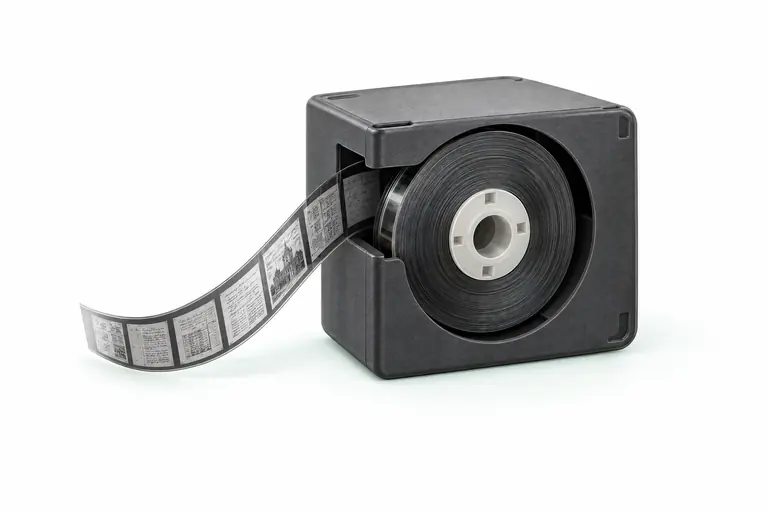
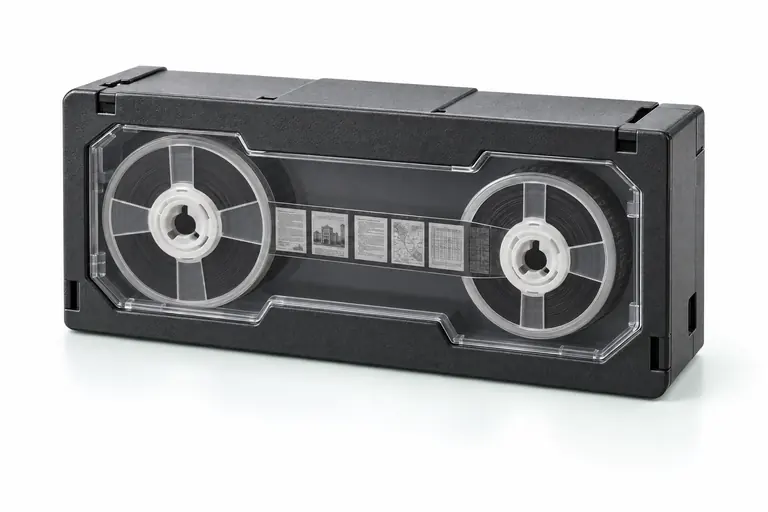
A cartridge has one hub; a cassette encloses two cores.
Layout
Simplex is one-up and duplex is two-up; this does not mean paper front and back.
Simplex and duplex guidePolarity
Positive has dark text on a light background; negative reverses that relationship.
Positive and negative guide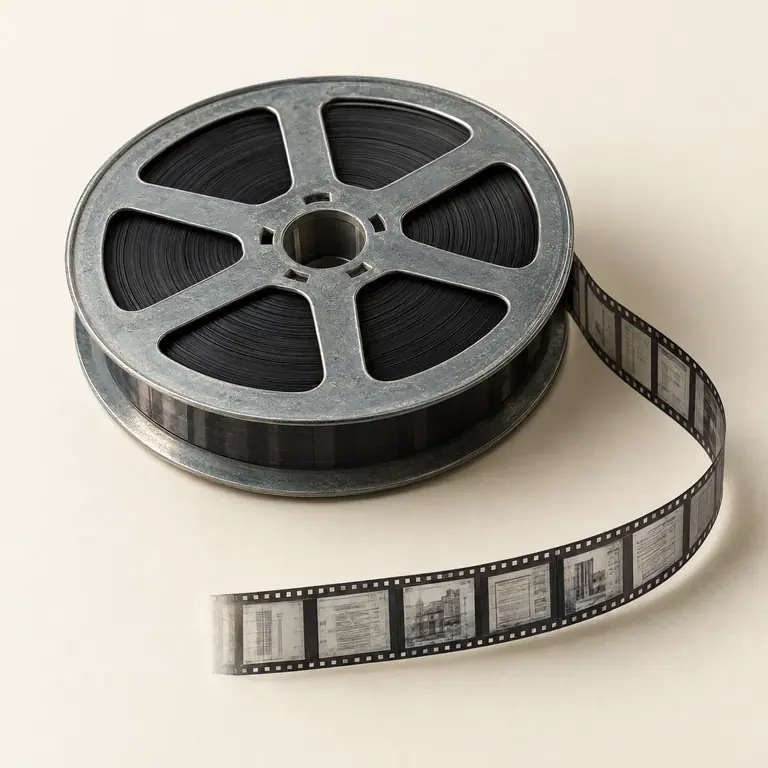
Blips or optical marks
Marks can appear as distinct rectangles along a film edge. Their meaning is collection-specific.
Blipped film image marks guideUse the physical definitions
A reel is film wound on an open flanged holder. A loose roll is a wound length of film that is not on a reel, cartridge, or similar holder. A cartridge encloses film on a single hub in a protective container; its free end is normally threaded into compatible equipment. A cassette encloses film on a double core and is used without manually threading the film in compatible equipment.
The Library of Congress notes that 16 mm is a usual cassette width and that cassette lengths are commonly 100 feet or less. That describes a common pattern, not a reason to relabel every small container as a cassette. Record the carrier you can actually observe, plus labels and manufacturer or collection markings where available.
| Carrier | Construction | Planning implication |
|---|---|---|
| Open reel | Film wound on a flanged holder | May need compatible manual threading |
| Loose roll | Wound film without a holder | Needs careful identification and support |
| Cartridge | Single hub in a protective case | Access depends on compatible equipment and condition |
| Cassette | Film enclosed on double cores | Designed for non-manual threading in compatible equipment |
Do not force a carrier to fit a label
The National Archives cautions that film wound inside cartridges may not be accessible on available equipment and recommends consulting a preservation specialist before removing it for viewing or digitization. That is why an inventory should flag cartridges as cartridges rather than count them as ordinary reels.
A carrier can also have collection-level meaning. A cartridge label, cassette case, leader, reel box, or accompanying list may carry the only visible series or sequence reference. Keep that relationship intact in the inventory. Moving film between carriers or attempting a repair can destroy useful context and introduce handling risks.
Capture details that support a later review
A simple inventory row can include container ID, carrier type, film width, approximate reel or case size, visible label, polarity, reduction if marked, condition observation, and sequence position. Do not convert an unknown object into an assumed format simply to make a spreadsheet uniform; use “unknown carrier—review needed” where the evidence is unclear.
Fictional example — no PII: “Cabinet 2, item 44: 16 mm cartridge, label ‘Claims 1988 Q3’, film end not accessed, case intact, positive/negative not confirmed.” It accurately records what is known and identifies the unanswered question without asking staff to open the carrier.
Link carrier facts to the intended outcome
Carrier information informs access and handling; it does not by itself dictate a digital file format, indexing scheme, or OCR result. A project brief should separately state what users need to find, any existing indexes, the requested derivative or repository destination, and known condition concerns.
If a collection mixes open reels, cartridges, and cassettes, separate them in the inventory so representative samples reflect each group. National Microfilm can review the collection description and intended retrieval needs as part of project-specific scoping.
Go deeper on the material you have.
Detailed identification clues, capture considerations and retrieval questions for these formats.
Common questions
Is a cartridge just a protective reel case?
No. A cartridge is a distinct carrier with a single hub and its own access requirements.
Can I call any small film container a cassette?
No. A cassette has a double-core enclosed construction. Record the observed carrier rather than using a generic label.
Should cartridge film be pulled out to measure it?
No. Do not remove it solely for identification. Record visible information and seek collection-appropriate guidance.
Sources & further reading
These references explain technical formats, standards or destination requirements. They do not imply endorsement of National Microfilm.