
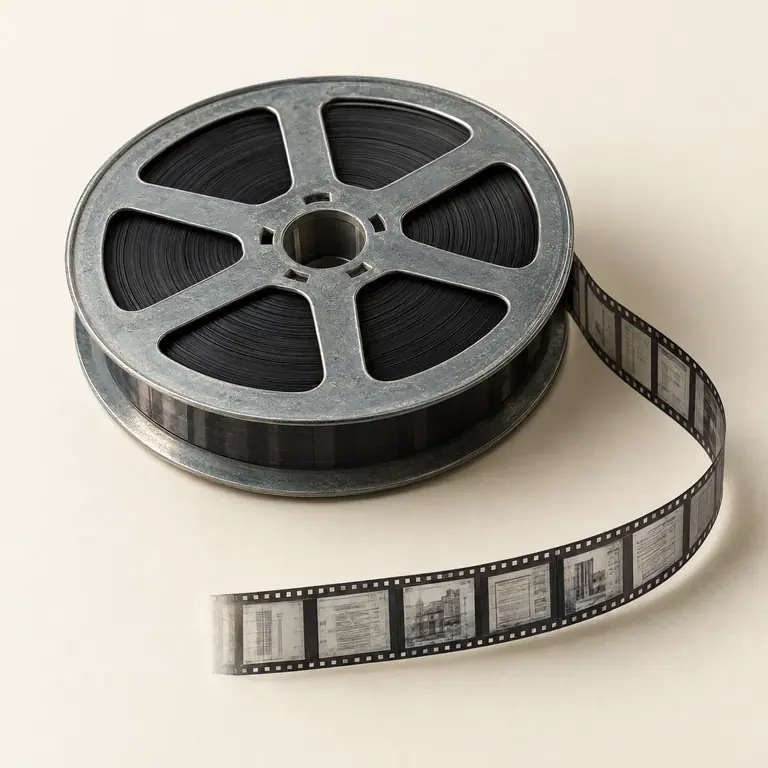
Recognize the format.
A 16 mm-wide strip of microfilm whose carrier, layout, polarity, reduction, and material are identified separately.
- The transparent film strip measures 16 mm wide.
- Microimages appear in a linear sequence along the strip, not in a fiche grid or card aperture.
- The strip may be on an open reel or enclosed in a cartridge or cassette.
16mm microfilm: what to look for
Three useful notes for your project
- Measured 16 mm width and carrier form: reel, roll, cartridge, or cassette.
- Visible labels or targets, marked reduction ratio, and any ratio change.
- Polarity, layout, image marks, leader, and condition observations.
What 16mm microfilm means
16mm microfilm is photographic microfilm whose strip is 16 millimeters wide. It does not name the original paper size, reduction ratio, image layout, film base, or carrier. The Library of Congress treats width as a physical dimension of the film itself; even a 16 mm image on 35 mm film is cataloged as 35 mm film.
Confirm width from the object, then record the carrier: a roll, open reel, single-hub cartridge, or double-core cassette. Carrier affects loading but not width. Both 16 mm and 35 mm are common widths for textual and graphic material. Library of Congress guidance also notes 16 mm film at 24:1 or 48:1 as a common computer-output microfilm use. COM means computer-output microfilm, not a bibliographic catalog by definition.
Technical references:[1]
Separate width from layout, polarity, and capture quality
Width is only one attribute. Record simplex or duplex layout, cine or comic reading orientation, and positive, negative, or mixed polarity. Positive images have dark characters on a light background; negative images reverse that relationship. These observations guide framing and review; they do not identify the record type or film material.
Some rolls have rectangular optical image marks, formerly called blips, in a channel above or below the image area. GPO defines them as retrieval aids for counting or locating frames. Preserve their presence and placement without assuming that every reel has them. FADGI explains that microfilm is digitized at a fixed PPI relative to the film, regardless of reduction ratio. Focus, density, scratches, and the information already on film affect usable detail, so a representative sample is more useful than a universal setting.
Plan indexing, OCR, and outputs as separate choices
OCR creates searchable text from visible characters; indexing creates a reliable retrieval structure. They work together, but OCR should not be the only route to a high-value record. Tiny characters, high reduction, faint density, skew, complex columns, handwriting, and damage can limit recognition. Sample results should determine whether OCR is useful as an access layer and which fields need visual verification.
Illustrative indexing example: a reel of municipal meeting agendas could retain collection “City council agendas,” reel ID “CC-1978-04,” frame 000127, meeting date 1978-04-12, and document title “Agenda.” The frame reference anchors the description to a stable visual location if OCR misreads a word. Decide separately whether the approved outcome needs preservation reference files, access files, import-ready metadata, or a combination. National Microfilm can review samples to define image files, index fields, OCR role, and approved delivery scope.
Prepare film without changing the carrier or record order
Keep reels, containers, labels, targets, and existing sequence together. Note visible IDs, carrier type, approximate quantity, leader, labels, and any interruption in order. A cartridge contains film on one hub; a cassette is double-cored. Do not dismantle either to classify it.
NARA advises edge-only handling with gloves, clean equipment, and inspection for distortion, redox blemishes, or signs of acetate deterioration. Do not use household tape to repair broken film. If material is damaged, unusually tight, or needs removal from a cartridge for access, seek preservation guidance first. Do not infer base, emulsion, generation, or condition from age or color alone: support dates overlap, and these attributes are separate from width and polarity.
Recognize common uses without treating them as rules
16 mm film often appears in document-oriented reels and can also contain computer-generated output. Neither use follows from width alone. A roll may hold paper-record images, a system-generated report, or mixed material; carrier, targets, reduction, and layout are better planning evidence than the format name.
An open reel does not prove a standard frame count, a marked reduction does not guarantee legibility, and an older-looking strip does not identify its chemistry. A batch may need more than one capture profile when polarity, reduction, layout, or condition changes. Sample review identifies those exceptions before production choices are set.
Questions to answer in a sample review
Use representative material from the beginning, middle, and end of a reel or batch, plus visible labels and targets. Ask whether every item is 16 mm, whether carrier types match, and whether reduction, polarity, orientation, image quality, or image marks change. If reduction is unknown and no scale appears in the image, FADGI notes that original-document scale can be lost in digitization.
Then define retrieval: is reel-level description enough, or are date, document type, frame, report period, or another frame-level field required? Identify values that need visual checking and whether OCR is only a discovery aid. Finally, confirm approved file, metadata, and delivery requirements. National Microfilm uses this sample-based discussion to scope scanning, indexing, OCR, and delivery without promising recovery that the film cannot support.
Common questions
Is 16mm microfilm a document size?
No. It identifies the width of the microfilm strip, not the dimensions of the original document or a digital scan.
Is every 16mm item an open reel?
No. The same 16 mm film width can be found as a roll, on an open reel, in a single-hub cartridge, or in a double-core cassette. Carrier form should be recorded separately.
Does COM mean a catalog of bibliographic records?
No. COM means computer-output microfilm: film recorded from computer-generated data. It can contain reports, lists, forms, or other system output.
Will OCR make every 16mm frame fully searchable?
No. OCR results depend on the visible image, including character size, reduction, focus, density, damage, layout, and text style. Sample review helps define its appropriate role.
Sources & further reading
These references explain technical formats, standards or destination requirements. They do not imply endorsement of National Microfilm.
- Library of Congress MARC 21 Bibliographic: 007 Microform
- National Archives Film-Based Negatives and Positives
- FADGI Technical Guidelines for Digitizing Cultural Heritage Materials, Third Edition
- U.S. Government Publishing Office Quality Attributes for Microforms
- Missouri State Archives Guidelines for Preservation Microfilming