
Recognize the format.
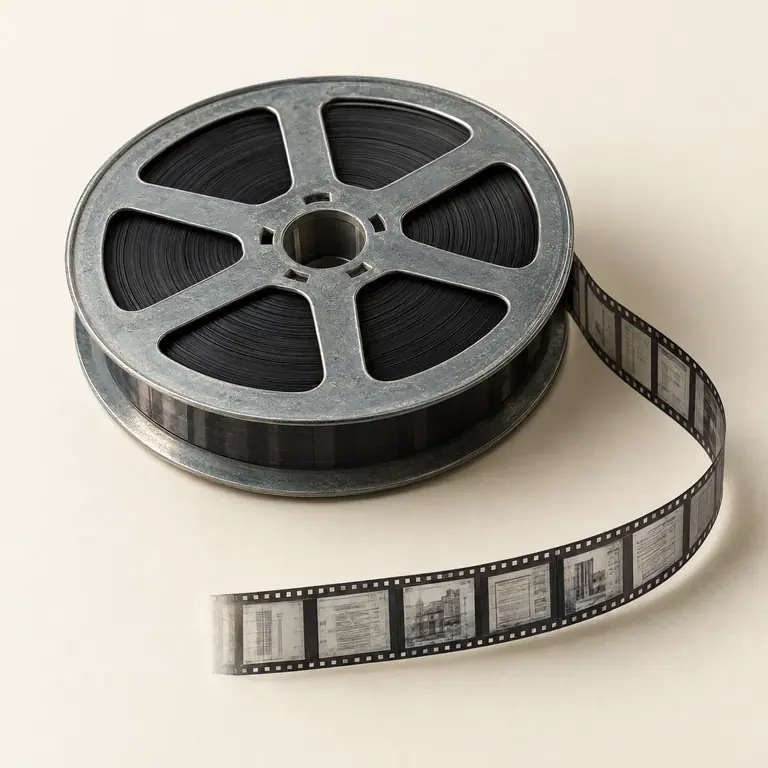
A 35 mm-wide microfilm strip whose carrier, layout, polarity and material must be identified separately.
- A transparent film strip measures 35 mm across at the film edge.
- Microimages repeat in sequence along a continuous strip rather than a fiche grid.
- An open flanged reel may be present, while any other carrier needs separate identification.
35mm microfilm: what to look for
Three useful notes for your project
- Measure the film width and note the carrier: reel, loose roll, single-hub cartridge, two-core cassette or mounted card.
- Record frame layout and orientation, visible targets or reduction changes, image marks, and positive, negative or mixed polarity.
- Retain labels and sequence; note condition and document any known emulsion, base or generation without inferring them from age or color.
35mm is a film-width measurement
35mm microfilm is microfilm whose physical strip is 35 millimeters wide. That direct definition is important: width does not identify the size of the original paper, the image area, the number of frames, the reduction ratio or the scan sampling setting. The Library of Congress catalogs microfilm width separately from those characteristics.
Identify the carrier separately. A reel is an open flanged holder; a roll is film not on a reel, cartridge or similar holder; a cartridge has one hub; and a cassette has two cores. A 35mm image can also be mounted in an aperture card, but the card is a distinct carrier format and its configurations vary. COM means computer-output microfilm, a production method rather than a subject or bibliographic category.
Technical references:[1]
What a 35mm roll can tell you—and what it cannot
The Library of Congress identifies 35mm and 16mm as the common reel widths for microimages made from textual and graphic materials. It is reasonable to expect sequential frames on a 35mm roll, but not to assume a particular record type or original document size. The actual collection may include page images, graphics, targets, title frames or image marks in an order set by its original filming workflow.
A National Archives census program provides one qualified example: its positive microfilm copies used 35mm or 16mm reels and reductions from 12.1:1 to 20.1. That describes that program, not every 35mm reel. At intake, record polarity as its own fact: positive images have dark characters on a light background, negative images have light characters on a dark background, and a roll can be mixed.
Capture choices begin with the filmed image
A 35mm width does not guarantee legibility. Review representative frames for focus, density, contrast, page edges, fine detail, scratches, dirt, missing content and changes in reduction or orientation. These are attributes of the filmed record and can limit what a digital image can show; adding pixels cannot recreate detail absent from the film.
Reduction ratio describes the relationship between the original document and its film image. FADGI explains that microfilm is digitized at a fixed PPI relative to the film, regardless of the original reduction ratio. When known, preserve the ratio as metadata because it helps relate the digital image to the original document scale. National Microfilm reviews representative samples to define scanning, image review and approved delivery scope rather than applying a universal setting.
Keep image capture, indexing and OCR distinct
The image file preserves what appears on the film. Indexing supplies deliberate retrieval fields, while OCR attempts to make visible machine-printed text searchable. OCR can assist discovery, but it does not prove that every name, number or faint character was recognized correctly. Fields that must retrieve reliably should be defined from visible evidence, an existing finding aid or both.
Illustrative indexing example—not a customer record: a project could identify a reel as collection “Board Minutes,” reel “R-021,” sequence 3, target date range “1967-01 to 1967-06,” and frame “000342.” If a roll has image marks, retain them as navigation information: GPO defines an image mark, formerly called a blip mark, as an optical mark used to count or locate frames. National Microfilm can review sample-based scanning, indexing, OCR and approved delivery scope for the collection.
Prepare a 35mm collection without altering it
Preserve the existing order, boxes, reel labels, leader and target frames. Handle film by the edges with gloves, and note condition rather than attempting a diagnosis or a repair. For example, record visible scratches, distortion, a loose wind, missing labels or uncertain sequence, then keep that observation tied to the physical item.
Do not infer film base or emulsion from age, color or a copied label. The National Archives notes that film-support dates overlap and cannot identify the support by date alone. Keep a single-hub cartridge and a two-core cassette intact; do not dismantle either to make it fit another workflow. Damaged, deteriorating or uncertain material calls for preservation guidance before routine access handling.
Questions to bring to a sample review
A small, representative sample makes the physical format and intended retrieval outcome concrete before a full project. Include examples from the beginning, middle and end of a roll when available, plus any target frames, image marks or visible format changes.
- Has the film itself been measured at 35 mm, and what carrier holds it?
- Do labels, targets or title frames identify a sequence, reduction ratio, layout or orientation?
- Are polarity, density, focus, condition or reduction consistent across the sample?
- Which retrieval fields are required: collection, reel, date range, page, frame or another established identifier?
- Which approved deliverables are needed: image files, access copies, OCR text, structured index data or a mapped filename scheme?
Common questions
Is 35mm a scanning resolution?
No. It measures the physical width of the film strip. Scan PPI and the original document’s reduction ratio are separate capture facts.
Does 35mm identify a master or a service copy?
No. Film generation is a separate attribute. A master, printing master or service copy should be documented from collection information or inspection, not inferred from apparent image quality.
Can an aperture card contain a 35mm microfilm image?
Often, yes. The mounted 35mm image and the aperture card are different physical facts, so the card configuration and any visible metadata need separate review.
Will 35mm microfilm always produce usable OCR?
No. OCR performance depends on the filmed text, reduction, focus, density, condition and layout. Use a representative sample to set realistic searchable-text expectations.
Sources & further reading
These references explain technical formats, standards or destination requirements. They do not imply endorsement of National Microfilm.
- Library of Congress MARC 21 Bibliographic: 007 Microform
- National Archives 1910 Federal Population Censuses
- National Archives Film-Based Negatives and Positives
- FADGI Technical Guidelines for Digitizing Cultural Heritage Materials, Third Edition
- U.S. Government Publishing Office Quality Attributes for Microforms
- Missouri State Archives Guidelines for Preservation Microfilming