
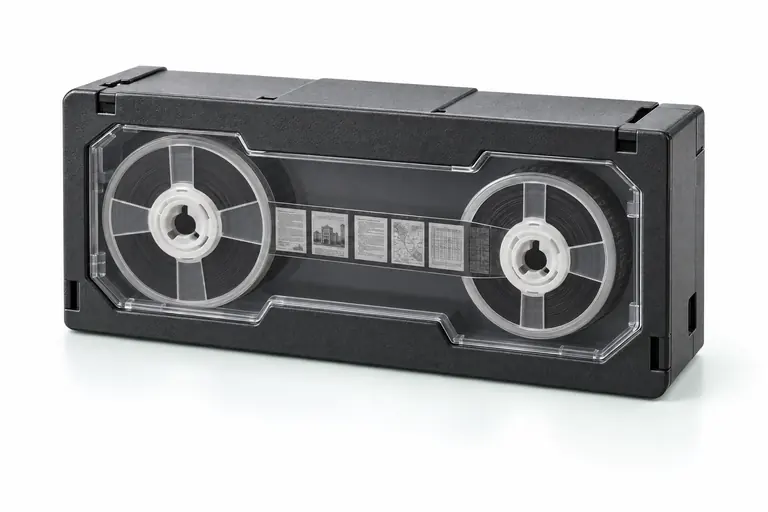
Recognize the format.
An enclosed microfilm carrier whose film travels between two internal cores instead of winding from a single hub.
- Enclosed shell instead of an open flanged reel.
- Two internal core positions rather than one hub.
- A cassette label or measurement may confirm 16 mm film.
Microfilm cassettes: what to look for
Three useful notes for your project
- Photograph the cassette, label, container, and visible identifiers.
- Record the cassette count, stated sequence, and any target information.
- Flag damaged shells, binding film, or uncertain compatible equipment.
What a microfilm cassette is—and is not
A microfilm cassette is a strip of photographic film wound on a double core inside a protective container. In a compatible reader or reader-printer, it is used without manually threading the film. The Library of Congress identifies 16 mm as the common cassette width and 100 feet or less as the usual length; these are common characteristics, not a substitute for measuring or reading the item label.
Do not use cassette and cartridge as interchangeable names. A cartridge has a single core or hub and normally leaves a free film end for threading into compatible equipment. A cassette has two cores. An open reel is different again: it is an unenclosed flanged holder. The carrier tells a scanner how film is accessed; it does not identify the records inside.
Technical references:[1]
Keep carrier, width, layout, polarity, and material separate
“Cassette” describes the carrier. Film width is a separate measurement; 16 mm is usual for a cassette, while the actual item can be confirmed from labeling or measurement. Image layout is another fact: pages may be simplex or duplex and oriented cine or comic. A target, title frame, or representative preview can reveal a sequence change that the shell cannot.
Polarity is also independent: positive images have dark characters on a light background, negative images have light characters on a dark background, and a run may be mixed. Emulsion, base, and generation are separate descriptive fields as well. Do not infer acetate, polyester, nitrate, silver, diazo, vesicular film, or master/service status from cassette color, the date on a box, or the carrier alone. COM means computer-output microfilm; it describes how images were recorded, not a cassette designation or a bibliographic catalog by definition.
Capture issues a cassette can hide
The shell protects the film but cannot show focus, density, scratches, cropped pages, missing frames, reduction changes, or where one record begins. A sample should include the beginning, a typical middle span, an apparent change in document type or target, and the end. Note whether frames are tightly spaced, rotated, or mixed in polarity before deciding how automatic frame detection and review will work.
For microfilm, capture resolution is set relative to the film, not automatically to the original paper size. If the reduction ratio is known, retain it in image metadata because it helps establish the original document scale. FADGI recommends scanning the full frame; it also cautions that older or photographically limited microfilm may support reasonable legibility rather than reproduction-quality images. A numerical scanner setting alone cannot restore detail absent from the film.
Plan retrieval fields before relying on OCR
Indexing gives each image or record a dependable route back to its source; OCR turns visible machine-printed characters into searchable text. OCR can assist discovery, but it does not establish a reliable index for faint, tiny, skewed, damaged, handwritten, or complex pages. Retain the image and use visible targets, labels, existing finding aids, and review to define the fields that must be retrieved consistently.
Image marks, formerly called blips, can support automated counting or location when they are present and their use is understood. They are not document content and should not be assumed on every cassette. Illustrative indexing only: a capture could be linked as “cassette C-014 / frame 000237 / title target Monthly Operations Report / report date 1986-04,” with each value marked as coming from a label, target, image, existing index, or review. Output choices can then separate preservation-oriented images, access files, OCR text, and a structured index rather than treating one PDF as every deliverable.
Prepare cassettes without dismantling them
Keep cassettes in their existing order and keep labels, cartons, reel lists, target notes, and database exports associated with them. Photograph representative labels and record a stable cassette or container identifier before transfer. If film is exposed, handle it by the edges with clean gloves; keep equipment and work surfaces clean to reduce scratching and abrasion.
Do not dismantle a cassette, force a binding mechanism, trim film, or apply household tape. Note cracked shells, resistance, odor, distortion, redox blemishes, or unclear carrier access for assessment instead. National Microfilm reviews representative cassettes to align scanning, indexing, OCR, and approved delivery scope with the actual media and access needs.
Questions to bring to a sample review
A useful sample review resolves the physical carrier and the retrieval goal together. Ask whether the reader or scanner is compatible with the cassette; whether labels or targets identify a sequence; whether width, polarity, layout, reduction, and image condition vary; and which fields users need to locate records. Also decide whether frame-level images, grouped documents, searchable PDFs, OCR text, structured index data, or a combination is needed.
- Which visible identifier can remain the stable cassette-level key?
- Where do records begin and end when no target is present?
- Which fields require review rather than OCR-only extraction?
- What sample frames best represent the smallest text and weakest images?
Common questions
Is a microfilm cassette the same as a microfilm cartridge?
No. A cassette is a two-core carrier used without manual threading in compatible equipment. A cartridge is a single-hub carrier that normally has a free end for threading.
Does 16 mm film automatically mean it is in a cassette?
No. Sixteen millimeters describes film width, not the carrier. The same width can appear on a reel, in a cartridge, in a cassette, or in another microfilm form.
Can the cassette shell identify film material or generation?
No. Carrier, emulsion, base, polarity, and generation are separate attributes. Confirm known information from documentation and inspection rather than guessing from shell color or age.
Can OCR replace cassette and frame indexing?
No. OCR can make some printed text searchable, but a cassette/frame reference and agreed index fields preserve a dependable path to the captured image when OCR is incomplete or ambiguous.
Sources & further reading
These references explain technical formats, standards or destination requirements. They do not imply endorsement of National Microfilm.