
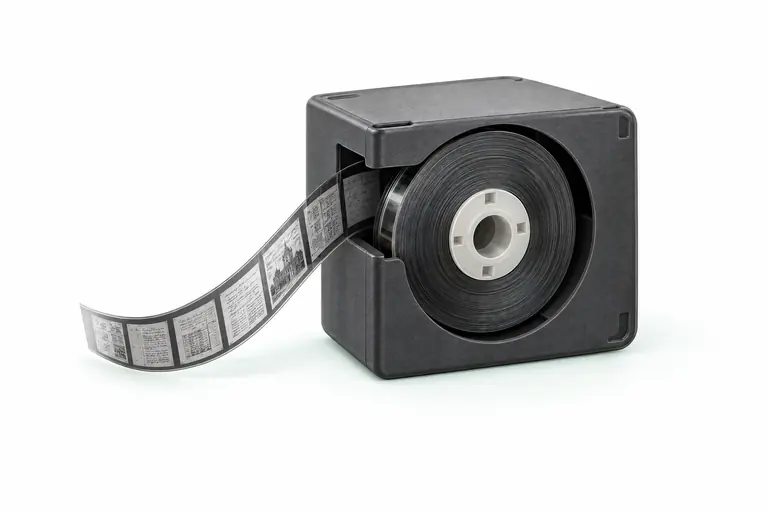
Recognize the format.
A microfilm cartridge encloses film wound on one hub in a protective container, typically with a free end for compatible equipment.
- Film is enclosed in a protective case rather than on an open flanged reel.
- The housing uses one film hub, not the two cores of a cassette.
- A film end may be left free for threading into compatible equipment.
Microfilm cartridges: what to look for
Three useful notes for your project
- Carrier labels, identifiers, and any reader or equipment documentation
- Known film width, polarity, reduction, and visible targets or image marks
- Condition observations, accessible leader/end, and equipment-access limits
Identify the carrier before describing the film
A microfilm cartridge consists of photographic film wound on a single core or hub inside a protective container. The Library of Congress says the film end is normally left free so it can be threaded into a reader or reader-printer adapted for cartridges. a cartridge is a single-hub carrier, not another name for an open reel or a two-core cassette.
Keep the dimensions separate at intake. “Cartridge” names the carrier; 16 mm, 35 mm, or another measurement names film width; simplex or duplex describes image layout; positive, negative, or mixed describes polarity; and emulsion, base, and generation are separate film attributes. The carrier alone does not establish any of those properties, the record subject, or the original document size.
Technical references:[1]
Distinguish cartridges from reels, rolls, and cassettes
An open reel holds film on an unenclosed flanged holder and is manually threaded. A roll is wound film that is not on a reel, cartridge, or similar holder. A cartridge protects film on one hub. A cassette instead encloses film on a double core and is not threaded in compatible readers. These are equipment-compatibility distinctions, so a project inventory should retain the carrier term printed on the item when available.
The Library of Congress notes that cartridge film can share the common lengths, widths, and reduction-ratio ranges of reel film. That does not make every cartridge identical. Its contents may have different frame layouts, labels, targets, polarity, or condition. A cartridge can therefore appear in an otherwise reel-based record series while still requiring a different access path.
Technical references:[1]
Plan capture around access and image evidence
A cartridge must be accessible in compatible equipment before a capture workflow can be confirmed. The National Archives cautions that some film wound inside cartridges may not be accessible on available equipment and says to consult a preservation specialist or photograph conservator if removal is needed for viewing or digitization. Do not remove or dismantle cartridge film simply to identify it, count it, or force a loading method.
Once access is established, assess representative frames for focus, density, polarity, scratches, reduction changes, blank sections, targets, and image marks. An image mark, sometimes called a blip, is an optical mark used by a retrieval system to count or locate frames; it is not the document image itself. FADGI explains that microfilm is digitized at a fixed PPI relative to the film, while known reduction ratio helps preserve information about the original document scale in metadata.
Separate retrieval indexing from OCR and output files
A usable delivery can keep carrier-level context connected to frame images. Possible fields, where visible and agreed, include cartridge ID, box or series ID, film width, source sequence, frame or image-mark reference, visible date, and a record identifier. Illustrative example — no customer data: `CAR-014 / frame 00327 / report period 1988-04` can link a file to a cartridge and a stable frame reference without claiming that every collection has those fields.
OCR can provide searchable text from visible machine-printed content, but it does not replace the image or prove a complete reading. Focus, density variation, reduction, damage, original document quality, and layout can limit recognition. Decide separately whether the needed result is a preservation-oriented image, an access image or PDF, OCR text, structured index data, or a combination. National Microfilm reviews sample-based scanning, indexing, OCR, and approved delivery requirements for the collection at hand.
Prepare a cartridge batch without changing the source
Keep cartridges in existing order and retain their boxes, labels, target information, and associated lists. At intake, note the carrier ID, label text, known film width, visible leader/end, apparent polarity, known reduction, image marks, and any reader documentation. Record uncertainty as uncertainty: do not infer film base, emulsion, generation, or chemical condition from a cartridge’s age or housing color.
Handle microforms by the edges and keep equipment and surrounding work surfaces clean to reduce abrasion risk. Flag cartridges with damaged housings, loose film, a stuck or inaccessible end, visible distortion, or other condition concerns for appropriate review. This is preparation for assessment, not a request to repair, open, or rewind the cartridge outside a compatible, planned workflow.
Questions to bring to a sample review
Ask whether the available equipment is compatible with the actual cartridge, whether the film end can be accessed without altering the carrier, and whether labels or targets establish a usable sequence. Also ask whether one cartridge contains changes in polarity, reduction, density, orientation, or frame layout. These facts affect capture setup and whether automated frame detection needs review.
Define what a user must find after delivery. Illustrative example — no customer data: a records team may need to retrieve “Series B, cartridge 12, invoice 1048,” while a researcher may need an OCR-assisted search across printed report pages. The first need calls for agreed structured fields; the second may add OCR, with visual images retained as the source evidence. Bring difficult and typical samples, not only the clearest film, to the review.
Common questions
What is the difference between a microfilm cartridge and a microfilm cassette?
A cartridge holds film on one hub and normally has a free end for threading into compatible equipment. A cassette holds film on two cores and is not threaded in compatible readers.
Does a cartridge tell me whether the film is 16 mm or 35 mm?
No. Cartridge identifies the carrier. Film width, reduction, polarity, layout, emulsion, base, and generation must be identified separately from the item or reliable documentation.
Can microfilm be removed from a cartridge for scanning?
Some cartridge film may not be accessible on available equipment. The National Archives advises consulting a preservation specialist or photograph conservator if removal is needed for viewing or digitization.
Will OCR make every cartridge image searchable?
No. OCR can support discovery of visible printed text, but focus, density, reduction, damage, layout, and the original filming can limit results. Structured indexing remains useful for required retrieval fields.
Sources & further reading
These references explain technical formats, standards or destination requirements. They do not imply endorsement of National Microfilm.