
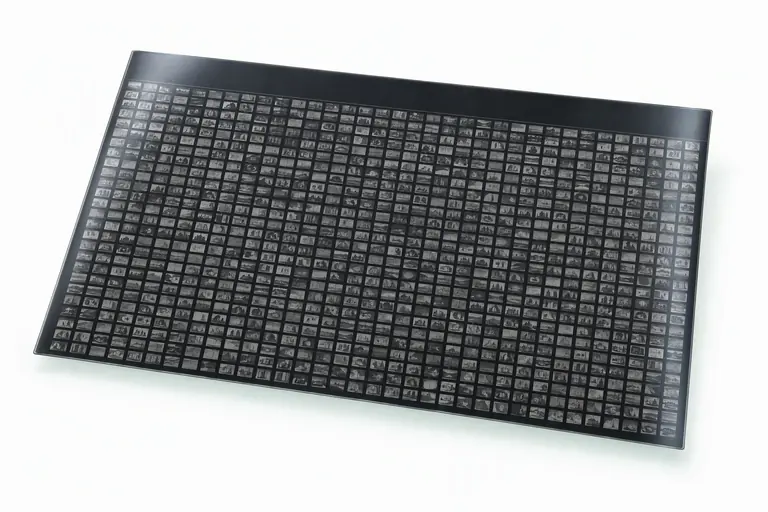
Recognize the format.
A flat microfiche with a verified reduction ratio greater than 90:1 and a nonstandard grid pattern.
- Flat transparent fiche with a heading and dense image grid
- Tiny closely spaced frames requiring magnification to inspect
- Marked or verified reduction ratio above 90:1
Ultrafiche: what to look for
Three useful notes for your project
- Fiche ID or header, sheet dimensions, and actual grid layout
- Visible reduction mark, polarity, condition observations, and targets
- Required retrieval fields, output use, and representative sample sheets
What ultrafiche is—and how to identify it
Ultrafiche is microfiche made at a reduction ratio greater than 90:1. It is a reduction category, not a fixed sheet size, standardized grid, film chemistry, or scanner setting. The Library of Congress defines microfiche as a transparent sheet with a two-dimensional image grid and a readable heading; it says ultrafiche grids and ratios are not standardized.
A dense flat fiche does not prove ultrafiche. Confirm a marked ratio over 90:1 where available, or compare the microimage with reliable original-dimension information. Record the carrier, sheet height and width, actual layout, polarity, and identified material separately. One attribute does not establish the others.
What the physical format can—and cannot—tell you
A common microfiche sheet is about 105 × 148 mm, but that size is not proof of ultrafiche and does not predict frame count. Federal specifications document standard 24:1 and 48:1 layouts; ultrafiche is above ordinary examples and has no standardized grid. Tiny, closely spaced frames are a reason to inspect more closely, not proof of a ratio.
The format name does not identify the records inside. Header text, collection documentation, and frame content may show report-style output, source-document pages, or another arrangement. Do not assume COM from grid density: COM means computer-output microfilm, while ultrafiche means ultrahigh reduction. Document the current access need because some ultrafiche may require specialized reading equipment.
Capture quality starts with available image detail
At more than 90:1 reduction, small characters and frame boundaries need a representative capture test before settings or outputs are finalized. Focus, density, contrast, scratches, original filming, and the capture system affect usable detail. Digitization can preserve access to the image on the fiche; it cannot recreate characters or lines absent from it.
FADGI explains that microfilm is digitized at a known PPI relative to the film, not automatically at the original-paper size. Record a known reduction ratio as metadata, capture the full microimage frame, and retain required heading or target context. A nominal PPI is not a promise of original-document detail, legibility, or OCR results.
Keep image, index, OCR, and output decisions distinct
Indexing provides a reliable route to an image; OCR creates searchable text from visible characters. For ultrafiche, a fiche ID, header, sequence, and stable frame position may be more dependable than OCR alone. Output planning can distinguish full-frame image files, access images or PDFs, OCR text, and structured metadata.
Illustrative example — no PII: a fiche headed “Quarterly Claims Summary, 1987 Q3” could use `series`, `reportPeriod`, `ficheId`, `row`, `column`, and `imageId` after the header and frame relationship are verified. OCR may support phrase searching, but source-linked index fields remain important for known-item retrieval. High reduction, faint characters, complex columns, and uneven density can limit recognition.
Prepare the fiche without changing the source
Keep fiche in existing order with their sleeves, labels, drawer references, and finding aids. Handle them by the edges with gloves. Note curling, scratches, dirt, distortion, redox blemishes, missing sheets, and unclear headers, then use the agreed review path rather than trying to flatten, repair, or clean with liquids or chemicals.
Do not infer emulsion, film base, generation, or a condition diagnosis from age or color. Clean equipment and work surfaces matter because dust can scratch film. National Microfilm reviews sample-based scanning, indexing, OCR, and approved delivery scope around the collection and its stated retrieval needs.
Questions to settle in a sample review
Include clear and difficult sheets: the smallest text, faint or dense frames, irregular grids, unusual headers, and any mixed polarity. Ask whether reduction is marked or documented, whether the full frame and heading are required, whether boundaries can be located consistently, and which retrieval fields must be dependable.
Also ask what users must read, search, and verify; whether row-and-column references are meaningful; whether an existing index can be reconciled; and how uncertain OCR or unreadable frames should be labeled. A sample review does not guarantee identical results for every sheet. It supplies evidence for collection-specific capture, indexing, OCR, and delivery decisions.
Common questions
What reduction ratio makes a fiche ultrafiche?
Ultrafiche means microfiche reduced more than 90:1. Library of Congress guidance places 61:1–90:1 in the very-high range and ratios above 90:1 in the ultrahigh range.
Does a dense 4 × 6 fiche grid prove that it is ultrafiche?
No. A common 105 × 148 mm sheet and a dense grid do not establish the ratio. Confirm a reduction mark or reliable dimensional evidence, because ultrafiche grids are not standardized.
Will ultrafiche OCR make every page searchable?
No. OCR can support discovery, but tiny characters, reduction, focus, density, damage, and complex layouts can limit results. Use sample review and source-linked indexing for fields that must be found consistently.
What should be indexed when each fiche has many tiny frames?
Use verified header and fiche identifiers, then retain a stable frame reference such as row and column when that matches the actual grid. Add approved record fields only when their source is clear.
Sources & further reading
These references explain technical formats, standards or destination requirements. They do not imply endorsement of National Microfilm.
- Library of Congress: MARC 21 Microform 007
- Library of Virginia: Guidelines for Microfilming Records
- NIST FIPS PUB 54-1: COM and Source Document Microfilming
- FADGI Technical Guidelines for Digitizing Cultural Heritage Materials
- Library of Congress: Microfilm Selection for Digitization
- National Archives: Film-Based Negatives and Positives
- Texas State Library and Archives Commission: To Microfilm, or Not to Microfilm