
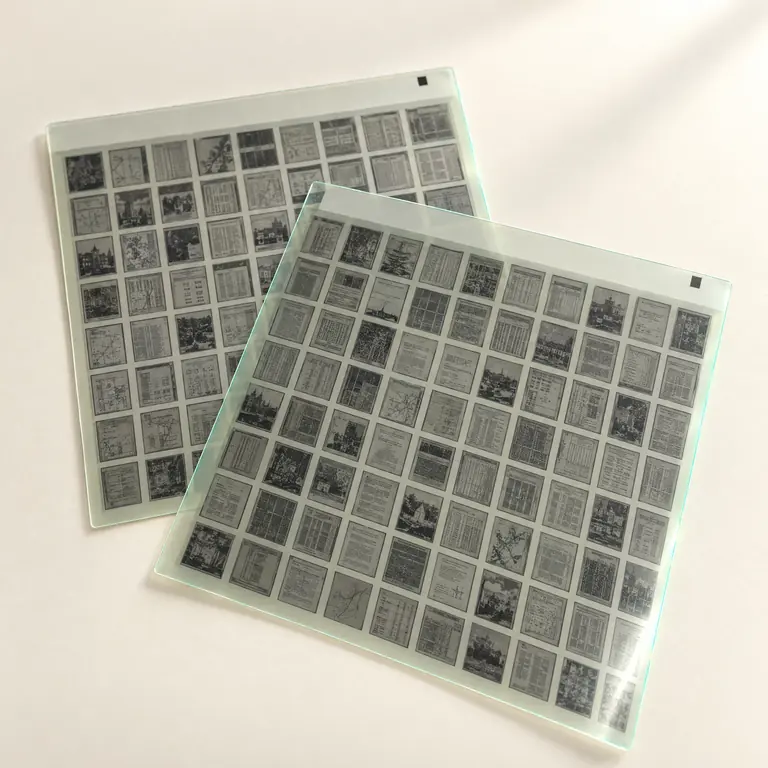
Four ways fiche can carry information
Form, production method and reduction are different dimensions, so these descriptions are not all mutually exclusive. A sheet count is not a page count, and grids vary by collection.
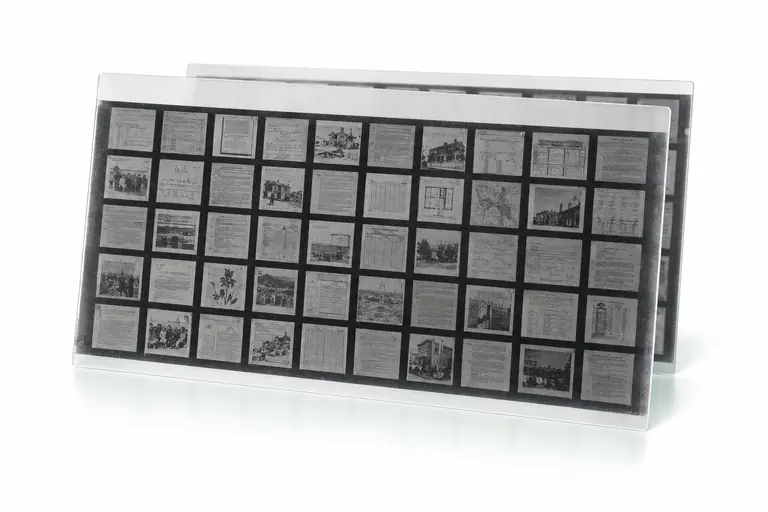
Source-document / step-and-repeat
A source document is reduced and placed frame by frame onto a fiche sheet. The header is retained separately from the image grid.
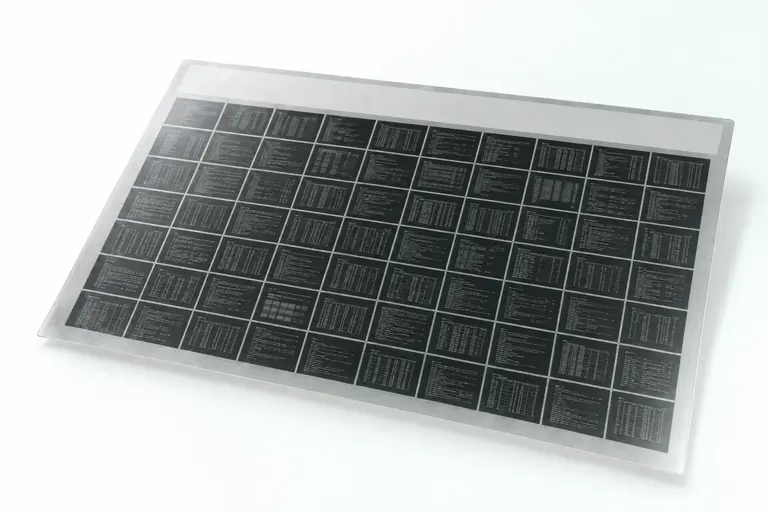
COM
Computer-output microfiche records computer-generated reports to fiche. COM is not a bibliographic catalog by definition.
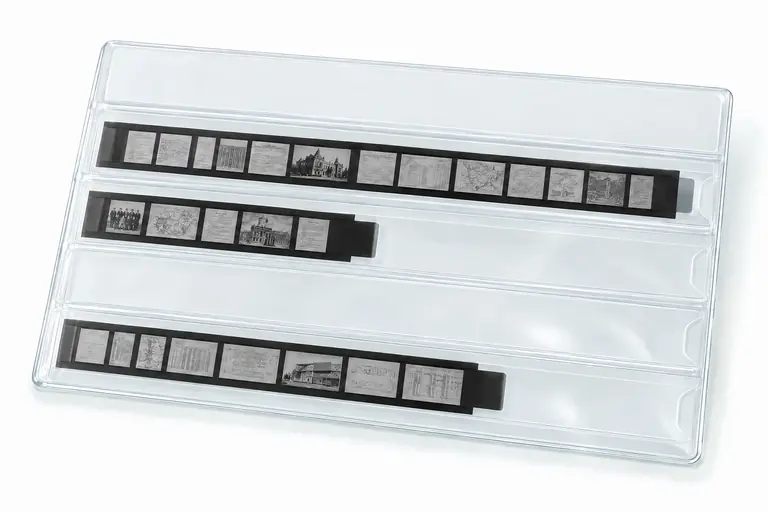
Jacket
A jacket is a transparent carrier with separate cut strips in channels, not two fiche sealed together.
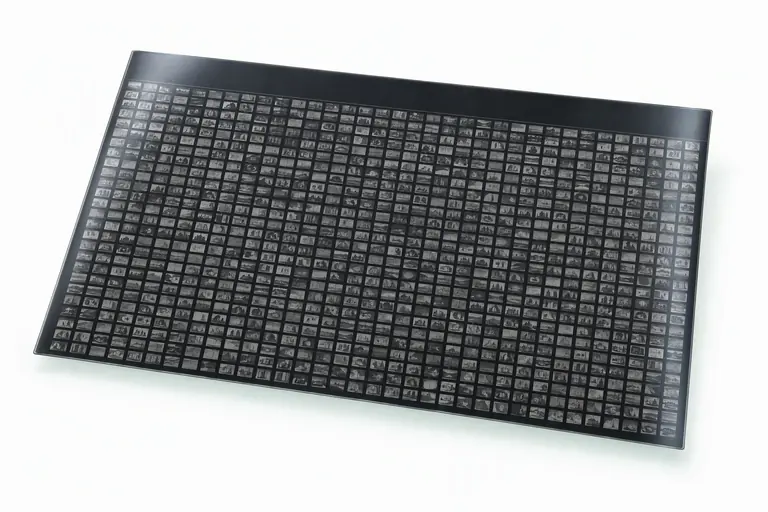
Ultrafiche
Ultrafiche is a high-reduction fiche format; it is not defined by card holes.
Same sheet. Different image density.
Read the ratio as a linear scale
At 24:1, an image on film is approximately one twenty-fourth of the source document’s linear dimension. It does not mean a scan should be made at 24 times a normal setting, and it does not reveal whether the original was sharply filmed. When a ratio is printed on the fiche header or documented in collection records, retain it as descriptive metadata.
The Library of Congress groups reductions below 16:1 as low, 16:1–30:1 as normal, 31:1–60:1 as high, 61:1–90:1 as very high, and above 90:1 as ultra-high. These ranges are useful vocabulary for description. They do not decide an output format, OCR result, or retrieval schema on their own.
Connect historic patterns without overgeneralizing
FIPS PUB 54-1 documents several 105 × 148 mm legacy formats. A 24/63 fiche has 63 frames in 9 columns and 7 rows. A 24/98 fiche has 98 frames in 14 columns and 7 rows. These patterns are associated with a named nominal reduction, but the standard also recognizes permissible ranges and different source-document contexts.
The same publication documents 48/270 as 18 columns by 15 rows and 48/420 as 28 columns by 15 rows. The familiar 48/270 layout is often associated with COM, yet a visible grid should still be inspected rather than assigned a type from capacity alone. Nonstandard grids, mixed reductions, and ultrafiche occur in real collections.
| Legacy designation | Grid | Planning note |
|---|---|---|
| 24/63 | 9 columns × 7 rows | Nominal 24:1; verify actual header and content |
| 24/98 | 14 columns × 7 rows | Nominal 24:1; common document-size context is not universal |
| 48/270 | 18 columns × 15 rows | Nominal 48:1; familiar COM pattern, not proof |
| 48/420 | 28 columns × 15 rows | Nominal 48:1; dense layout needs actual inspection |
Keep ratio separate from digital sampling
FADGI explains that microfilm is digitized at a known PPI relative to the microfilm itself, regardless of original reduction ratio. If the ratio is known, documenting it can help establish original-document size when combined with imaging resolution. If it is unknown and no scale exists, that historical scale may be lost in the digital representation.
Usable fine detail depends on more than a nominal PPI: scanner or camera response, focus, image density, processing, and the quality of the microimage matter. A high number of pixels cannot restore detail that was absent from the film. This is why representative samples are more informative than a universal resolution claim.
Record what can actually be verified
Note the ratio if it appears in a header, target, or credible collection documentation. Pair it with the fiche identifier, physical dimensions, grid, polarity, header text, and condition observations. If the ratio is unknown, write “not marked” instead of estimating it from a frame count or the sheet size alone.
Fictional example — no PII: “Fiche HR-12, 105 × 148 mm, 14 × 7 grid, header notes 24:1, positive polarity, two frames visibly out of focus.” This keeps historical capture information distinct from a proposed digital deliverable.
Go deeper on the material you have.
Detailed identification clues, capture considerations and retrieval questions for these formats.
Common questions
Does a 48:1 fiche need a 48-times-higher scan setting?
No. Reduction describes the original filming scale. Digital capture requirements are set from the film, intended use, and representative testing.
Can I calculate reduction from the number of grid cells?
Not reliably. Historic patterns are useful clues, but actual layouts and source document sizes can differ.
What is ultrafiche?
It is microfiche reduced above 90:1. Its grids and ratios are not standardized, so it benefits from sample-based review.
Sources & further reading
These references explain technical formats, standards or destination requirements. They do not imply endorsement of National Microfilm.