
Recognize the format.
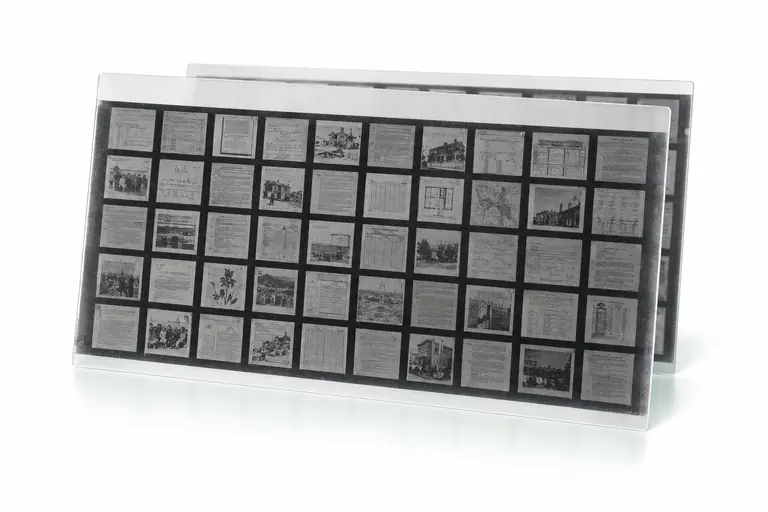
A flat fiche on which original documents were photographed as separate frames in a planned row-and-column grid.
- A transparent fiche sheet with a readable heading area and image grid.
- Separate, uniformly positioned document frames across rows and columns.
- A header or records documentation supporting camera-produced source-document filming.
Source-document and step-and-repeat microfiche: what to look for
Three useful notes for your project
- Fiche dimensions, header text, grid rows and columns, and any sequence identifier.
- Polarity, marked reduction ratio, orientation, and apparent missing, duplicate, or cropped frames.
- Condition observations and the fiche relationship to its drawer, folder, or finding aid.
Definition and identification
Source-document microfiche is made by photographing original textual or graphic documents into separate microimages. A step-and-repeat camera produces fiche by exposing those images on 105 mm film in an orderly row-and-column pattern. step-and-repeat describes the production method, not the film base, emulsion, polarity, generation, or final digital output.
Look for one transparent sheet, a heading area readable without magnification, and a two-dimensional grid of frames. A jacket is a different carrier: it holds cut microfilm strips in channels. COM means computer-output microfilm, so its images originate from computer-generated data rather than camera photography of source pages. A fiche can share size, polarity, or a grid pattern with another kind of fiche; classify the physical sheet and capture history separately.
Characteristics and record use
A common microfiche is about 105 × 148 mm, with a heading above the grid, but that common size does not establish a fixed frame count. The federal FIPS microfiche standard documented 24/63 as a 9-column by 7-row layout and 24/98 as a 14-column by 7-row layout. It identifies 24/63 as preferred for 14 × 11 inch source documents and gives source-document reduction ranges for other standardized layouts.
This format is encountered where separate paper record pages were camera-filmed onto individual fiche rather than recorded as COM output or cut from a roll into a jacket. Headers can carry useful control information such as record title, date span, and beginning or ending file numbers. Preserve that context, but do not treat a layout or header alone as proof of a particular film chemistry, generation, or complete sequence.
Capture and quality issues to review
Legibility depends on the original document and the historical filming as well as the fiche itself. Fine or faint text, focus, density variation, reduction, scratches, warped sheets, and incomplete or cropped frames can limit the detail available for capture. scanning can improve access to a recorded image, but it cannot recreate document detail that was not recorded on the film.
Review representative frames for the smallest required text, orientation, polarity, and whether the full frame is present. FADGI advises capture at a known PPI relative to the film, not a universal original-paper setting; when known, reduction ratio belongs in metadata because it helps interpret original scale. FADGI also notes that older microfilm may support reasonable legibility rather than reproduction-quality files, making sample review more useful than a blanket resolution claim.
Indexing, OCR, and output decisions
Build an index from evidence that is visible on the fiche or supplied in an authoritative finding aid: fiche identifier, header text, record series, source-page number, row and column, document date, or file number. Row and column can be a stable retrieval reference when printed page numbers are absent. Illustrative only: `Series: permits | fiche 0042 | row 3, column 9 | source page 127 | document date: 1968-09-18`.
OCR converts a raster text image into searchable text; it does not verify every character or replace structured indexing. Test it on representative pages before deciding whether to deliver OCR text, searchable PDFs, or an OCR field alongside the image. Define whether the header is captured, whether each frame becomes a file, how filenames map to the index, and which values need review. National Microfilm can review representative samples to align scanning, indexing, OCR, and approved delivery scope.
Non-destructive preparation and intake
Keep fiche in original order with its sleeve, drawer label, folder, or existing index whenever possible. Record headers and sequence breaks before capture, and separate only for documented handling or workflow reasons. Handle fiche by the edges while wearing gloves, keep work surfaces clean, and note curl, distortion, scratches, visible blemishes, or other condition concerns for review.
Do not write on the film, apply household tape, or attempt repairs or chemical cleaning as project preparation. Do not infer film base or emulsion from its age or color. National Archives guidance treats condition inspection as a prompt for preservation consultation when deterioration is suspected, not as a remote diagnosis.
Questions for a sample review
A representative sample should include the range of headers, layouts, reductions when known, image quality, and conditions found in the collection. That gives the review a realistic basis for identifying exceptions before output and indexing rules are set.
- Do the header and physical sheet identify a fiche sequence, record series, date range, or first and last file number?
- Are frames source pages, and are there mixed document sizes, orientations, positives, negatives, duplicates, or missing images?
- Which header, row-column, page, date, or file-number fields must support retrieval, and what evidence will validate each one?
- Should delivery retain one image per frame, header images, structured index data, OCR text, access files, or another approved combination?
Common questions
Is step-and-repeat a separate microfiche size?
No. Step-and-repeat names a camera production method. A 105 × 148 mm sheet is common, but the actual fiche dimensions, grid, and reduction should be inspected.
Does a 24/98 grid prove that a fiche is source-document microfiche?
No. The 24/98 layout is a useful legacy reference, but standardized microfiche layouts can accommodate different production contexts. Confirm the record history, header, and physical evidence.
Is a jacket fiche the same as step-and-repeat fiche?
No. A jacket is a carrier with channels for cut microfilm strips. Step-and-repeat refers to exposing separate images directly onto fiche film in a grid.
Will OCR make every frame fully searchable?
OCR can create searchable text from an image, but results vary with the source document, filming quality, reduction, focus, density, and condition. Sample testing is the practical way to set expectations.
Sources & further reading
These references explain technical formats, standards or destination requirements. They do not imply endorsement of National Microfilm.
- Library of Virginia Guidelines for Microfilming Records
- MARC 21 Format for Bibliographic Data 007 Microform
- FIPS PUB 54-1 Computer Output Microfilm and Source Document Microfilming
- FADGI Technical Guidelines for Digitizing Cultural Heritage Materials
- National Archives Film-Based Negatives and Positives
- Library of Congress Microfilm Selection for Digitization