
Recognize the format.
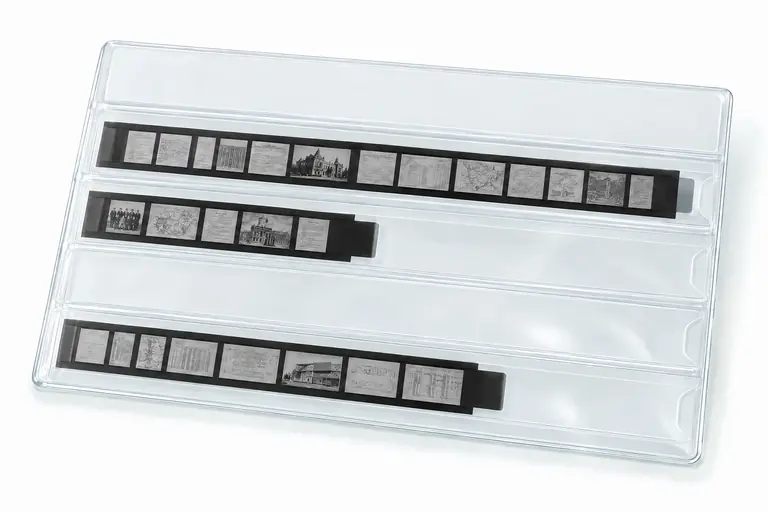
A transparent jacket carrier holds separate cut microfilm strips in one or more channels rather than one fixed image grid.
- Separate narrow film strips sit in parallel transparent channels.
- Channel seams or insertion openings are visible on the carrier.
- Frame runs can differ by channel or leave a channel empty.
Jacket microfiche: what to look for
Three useful notes for your project
- Jacket or header identifier, channel count, and visible label or stripe.
- Strip order, occupied or empty channels, shifts, splices, and frame ranges.
- Polarity, known reduction, and scratches, cracked channels, or other condition concerns.
What jacket microfiche is—and is not
a jacket microfiche is a flat transparent plastic carrier with one or more channels designed to hold processed photographic strips cut from roll microfilm. One channel can hold one or more microfilm images, so the carrier is not necessarily a uniform page grid.
“Jacket” names the carrier and filing arrangement, not the way the images were made. A collection can be described by several separate facts at once: jacket carrier, cut strip, known production method, polarity, reduction, and film material. In particular, COM means computer-output microfilm; it is not a bibliographic catalog by definition. A jacket is also not two fiche sheets sealed together.
Identify the carrier before assigning a scanning workflow
Look for separate narrow strips inside parallel transparent channels. Channel seams, insertion openings, locating holes, notches, or a color stripe may be visible, but their presence and arrangement vary. An empty channel, a shifted strip, or a strip with a different frame run is useful evidence to record rather than a defect to normalize away.
Keep the intake dimensions separate. Name the carrier as jacket microfiche; measure or record sheet and strip width when known; describe the layout as channel, strip order, and frame sequence; record positive, negative, or mixed polarity; and record emulsion, base, and generation only when identified. Age or color alone does not establish film chemistry or base.
Capture and quality issues specific to channels and strips
A jacket does not turn cut roll film into a fixed-grid fiche. Frames may start and stop at different places in different channels, and channel edges or shifted strips can affect framing. Sample captures should confirm that the full content of every selected film frame is included and that channel-to-strip relationships remain traceable.
Legibility is limited by the information on the microfilm as well as by the capture method. Focus, density, scratches, polarity, reduction, and the quality of the original filming can all matter. FADGI notes that digitization of monochrome microfilm and microfiche is performed at a known PPI relative to the film, not automatically to the original paper size; known reduction should be preserved in metadata.
Indexing, OCR, and output decisions
Use a jacket-aware retrieval path rather than assuming a row-and-column grid. A durable index can retain jacket identifier, channel number, strip sequence, frame sequence, visible header or label, polarity, and any collection-specific fields that are actually present. This provides a stable reference when a channel is empty, a strip is shorter than its neighbor, or a frame is unclear.
Illustrative example only: a file named JKT-0142 might have channel 03, strip B, frame 0007, with a visible document date and a source-page number. Those values can guide a filename or database record, while the scan remains the visual source. OCR can support discovery of machine-printed text, but it should not replace image review or source-linked indexing for fields that must be retrieved reliably.
Non-destructive preparation and intake
Preserve existing order and keep the jacket with its label, sleeve, box, or drawer context where those materials carry identification. Handle microfiche by the edges with gloves, keep equipment and work surfaces clean, and note cracked channels, scratches, dirt, shifted strips, splices, or missing sequence elements for review. Do not pull strips from channels to make them look more regular.
A useful intake inventory records the jacket ID, channel count, occupied channels, strip sequence, visible labels, known reduction, polarity, and condition observations. It should also distinguish a condition observation from a material identification: a review can record “base unknown” rather than infer a film base from color or a date.
Questions to resolve in a sample review
Start with representative jackets from each apparent pattern. Are the channels consistently occupied? Do strips shift, overlap, or contain splices? Are labels readable, and is the channel order meaningful? Do different strips show different polarity, reduction, density, orientation, or frame boundaries? The answers determine whether frame extraction and quality review can use one repeatable rule or need documented exceptions.
Also decide what must be delivered: frame images, a searchable PDF derivative, OCR text, a structured index, or files mapped to an approved destination. National Microfilm reviews representative samples to define scanning, indexing, OCR, and approved delivery scope. A sample review can identify constraints and evidence; it cannot guarantee that every frame will have the same legibility or OCR result.
Common questions
What is the difference between jacket microfiche and ordinary microfiche?
Jacket microfiche is a transparent carrier with channels that hold cut strips of processed roll microfilm. Ordinary microfiche is commonly a single transparent sheet with microimages arranged in a two-dimensional grid and an identifying heading.
Is jacket microfiche the same as COM?
No. Jacket describes the physical carrier. COM means computer-output microfilm, which is produced from computer-generated data; a jacket can be identified separately from the production method of the film it contains.
Can a jacket be indexed by grid position?
Not reliably by assumption. A better reference records the jacket identifier, channel, strip sequence, and frame sequence because channels may be empty and strips can have different lengths or frame runs.
Should strips be removed from a jacket before scanning?
Do not remove strips simply to regularize the layout. Preserve the carrier-to-strip relationship, handle the material by its edges, and flag damaged or shifted material for an appropriate review.
Sources & further reading
These references explain technical formats, standards or destination requirements. They do not imply endorsement of National Microfilm.
- U.S. Government Publishing Office Quality Attributes for Microforms
- MARC 21 Format for Bibliographic Data: Microform
- National Archives: Film-Based Negatives and Positives
- FADGI Technical Guidelines for Digitizing Cultural Heritage Materials, Third Edition
- Library of Virginia Guidelines for Microfilming Records