
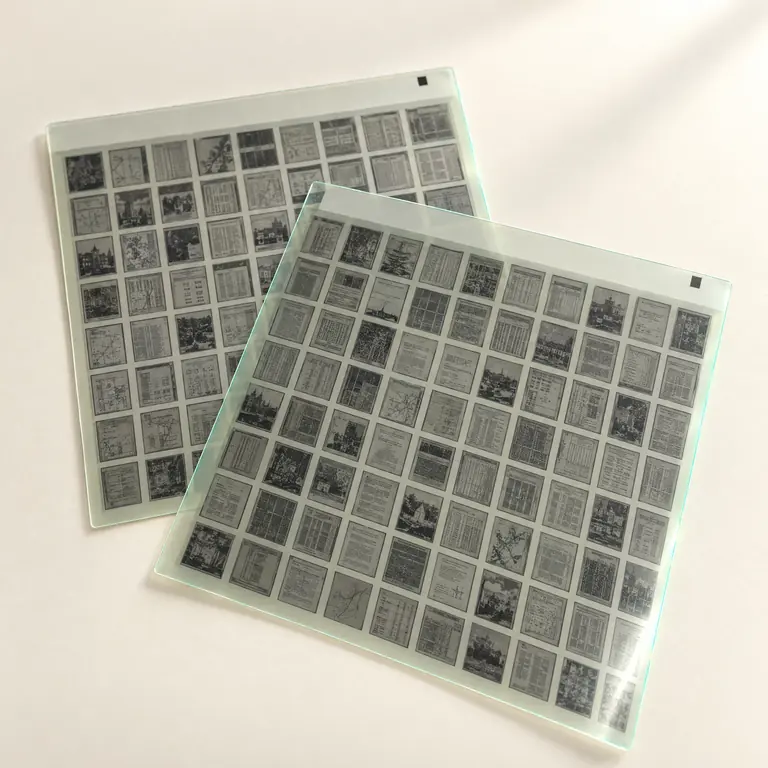
Example library retrieval fields
Example labels only. Final fields and source-to-destination mapping depend on the collection and require institution approval.
Same sheet. Different image density.
Start with the library-controlled collection
A library microfiche project begins with the collection the institution is authorized to convert: government-information fiche, special-collections material, cataloged sets, or another defined group. The goal is to carry forward enough context that a user can reconnect a digital image to the library’s collection, not simply to produce disconnected page files.
This scope excludes newspaper microfilm. It also does not provide public-record searches, document requests, or access decisions for individuals. The library identifies the material, applicable collection context, and the staff who can approve project choices.
Retain the collection’s retrieval context
Headers, call numbers, finding-aid references, and existing order can carry the context researchers need. A sheet may also need a fiche identifier and a row-and-column or frame reference. Jacket fiche can add jacket, channel, and strip relationships. The useful retrieval level is defined from the collection and the way the institution expects people to find it.
The following labels are planning examples, not a prescribed cataloging scheme. Existing catalog, finding-aid, or local collection data remains the source for the approved map.
| Possible field | Collection-specific purpose |
|---|---|
| Collection / series | Places the image in its library context |
| Call number | Connects to the approved catalog reference |
| Finding-aid reference | Retains an archival or series pointer |
| Fiche header / ID | Preserves the visible fiche-level identifier |
| Fiche-frame or row/column | Routes a user to an image position |
| Item date, if present | Supports the collection’s approved date retrieval |
Identify fiche without flattening the collection
Microfiche is a flat transparent sheet with a heading area and a two-dimensional image grid, but collections can mix source-document fiche, COM, jackets, or varying reductions. A header and grid are evidence to record, not proof that every sheet has the same layout or number of images.
An inventory can note visible headers, sheet or jacket counts, known collection order, mixed formats, existing lists, and condition observations. Where information is uncertain, it is better to flag it for review than to infer a grid, reduction, or record relationship from appearance alone.
Use a representative sample to set the plan
A representative sample can include clear and difficult fiche, different headers or grids, mixed polarity, dense pages, and any jackets or irregular material. It gives the project team a practical basis to discuss orientation, frame relationships, requested outputs, and the treatment of blanks, duplicates, or unclear images before broader production planning.
The sample also lets the institution review the proposed retrieval map against real records. It does not establish that every sheet will have identical image quality, layout, text recognition, or metadata. The resulting specification can document the approved approach and an exception path.
Keep access decisions with the institution
The institution determines rights, release conditions, access levels, and any restrictions for its collection. A digitization project does not itself confer public access, establish ownership, or change a library’s records, donor, or government-information responsibilities. Those decisions should be identified before the delivery workflow is finalized.
OCR may support discovery where printed text and image quality allow, but it is not a substitute for collection-approved identifiers or a promise that every fiche will be searchable. When a call number, header, or finding-aid reference matters for retrieval, it can be retained as an agreed, source-linked field.
Plan delivery around the approved workflow
Delivery planning can connect image files, requested OCR output, and the approved retrieval fields through a stable record identifier and a reviewable manifest. The library identifies its intended repository, file roles, field definitions, access owner, and any existing import or upload procedure before the production package is defined.
A test batch helps the institution review file relationships, collection context, mapped values, and exceptions in the chosen workflow. Repository configuration and final loading remain institution-specific; a platform name alone does not imply a native integration or automatic import.
Common questions
Can library government-documents microfiche be included?
It can be scoped when the institution authorizes conversion and supplies the relevant collection context, access decisions, and approved retrieval map. This is not a public document-retrieval service.
Will every fiche have the same grid or frame count?
No. Grid layouts and frame counts can vary by production method, reduction, and collection. Visible evidence and representative samples should guide the plan.
Can OCR replace call numbers and finding-aid references?
No. OCR can support discovery where the source permits, while approved call numbers, headers, and finding-aid references provide structured collection context.
Is newspaper microfilm part of this service?
No. This page is limited to university-library microfiche and related collection planning; newspaper microfilm is a separate records context.
Sources & further reading
These references explain technical formats, standards or destination requirements. They do not imply endorsement of National Microfilm.